Elias gripped the neck of his violin, thumb steady, fingers poised. The old clock in the hallway chimed five. Evening sun slanted through the tall windows of the parlor, striping the worn rug and catching on the dark varnish of the instrument. He raised the bow and began to play.
He was preparing for the spring recital in town, one of the few chances he had to be heard outside the schoolhouse. The judges would sit stern-faced beneath the gaslight chandelier in Porter Hall, and every student from the county would be there with polished shoes and parents in their best clothes.
The violin had been his since he was twelve, passed down from a great uncle. No one knew exactly where it had come from, but the varnish was warm red-brown, the wood fine-grained and clean. When Elias played, it felt like the violin knew what he meant before he did.
“You’ll wear out your fingers,” his father had said that morning, passing the doorway on the way to the barn.
“I’ve got to get it perfect,” Elias replied, not stopping. “It has to be perfect.”
His mother had nodded once from the rocker, quilting in her lap, and said, “Play it like it’s telling your story, not someone else’s.”
Each night, Elias practiced after chores, alone in the quiet parlor. The rest of the family gave him space, as if the music set a boundary they dared not cross. His older brothers had once poked fun—called him fiddler boy—but they’d gone west now, and the teasing had faded like worn lace at the curtain hem.
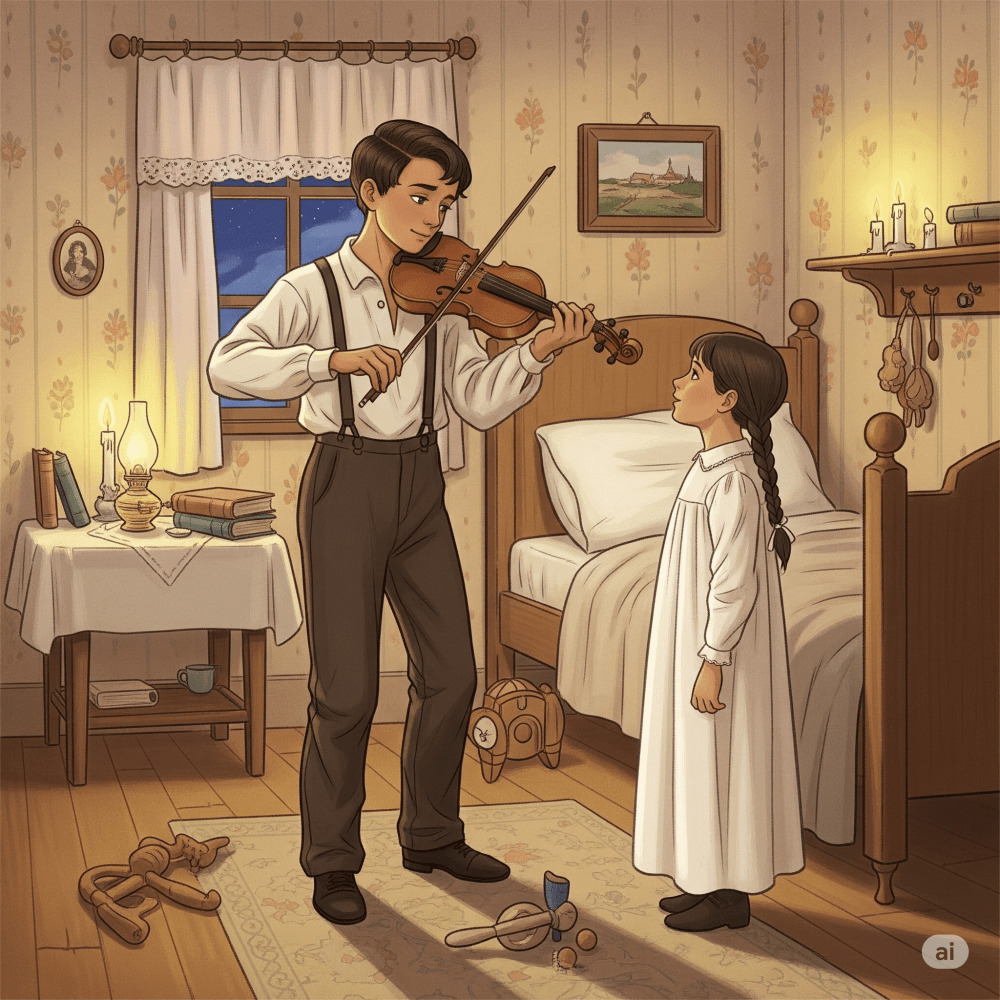
Elias closed his eyes. The bow moved, slow and sure. The melody curled up from the strings like smoke from a winter hearth—soft, searching. He could feel every note in his chest, like the violin’s voice was echoing inside him.
Down the hall, the floorboards creaked. His little sister peeked in, barefoot.
“Was that the one you’re gonna play?”
Elias lowered the bow. “I think so.”
“It sounds sad.”
“Not sad. Just real.”
She tilted her head, thinking. “I like it.”
He smiled. “Thanks.”
The next day, he woke before dawn. The house was hushed, the stove still cold. He carried the violin case as he walked to town—nearly three miles of dirt road and morning mist. At the crest of Miller’s Hill, he paused and looked out over the valley. Porter Hall sat in the distance like a paper model, neat and unassuming. Somewhere in that small square of roof and brick, the recital would begin.
When he reached the building, students milled on the steps, eyes shifting between each other’s cases, mouths tight with nerves. Inside, the air was warm and dry, the wood floors polished to a mirror. He found a seat and waited.
One by one, names were called. Some played sharp, some flat. One girl’s bow shook so badly the strings squeaked. Elias watched it all, hands resting on his case, trying not to think.
Then: “Elias Archer.”
He walked up. The violin was warm from his grip, the stage light soft on his brow. He drew the bow across the strings.
The melody floated out. It was the same piece he’d practiced, but now it felt looser, more alive. It didn’t sound like imitation or recitation. It sounded like the wind in the fields behind his house, like the weight of early mornings and a mother’s quiet pride. It sounded like him.
When he finished, there was silence. Then light applause, polite but hesitant. He nodded and stepped down.
Back in his seat, he didn’t look at the judges. He didn’t need to.
The sun was lower when he stepped outside, the sky tinged with orange. Some of the others laughed or sighed with relief. He just stood still, violin case in hand, feeling like he had said something important even if no one quite understood.
Later, they would post the results on the schoolhouse door. But in that moment, Elias didn’t rush to know. He looked up at the sky, exhaled, and walked home.
“What the Violin Knows” by Bright Bunny Books © 2025. Retelling of “The Soul of the Violin” from The Old House and Other Stories by Blanche Sellers Ortmann, originally published in 1910.
“What the Violin Knows” is intended for high school students, particularly those in grades 9–12, who can relate to themes of identity, perseverance, and quiet self-expression.
 Bright Bunny Books