No matter what happened, Jake always seemed to be the one caught in the middle of it. A dropped tray in the cafeteria? Jake was standing nearby. A soccer ball through the window? Jake’s foot was suspiciously close to the ball.
“It’s like you have bad-luck magnets stuck to you,” his best friend Marcus joked.
“I don’t do it on purpose!” Jake protested. “Stuff just… happens.”
That was partly true. Jake wasn’t mean-spirited, but he had a knack for mischief that spiraled out of control.
One Monday, his teacher, Ms. Rivera, returned to her desk after lunch to find three rubber ducks bobbing in her water pitcher. The whole class snickered. Only Jake’s grin gave him away.
“Jake,” Ms. Rivera said, raising an eyebrow.
He slumped in his chair. “Sorry. I thought it would be funny.”
At first, even Marcus laughed. But after the third or fourth mishap that week—like when Jake “accidentally” set off the fire alarm with burnt popcorn—laughter turned into eye rolls.
“You don’t get it,” Marcus whispered after school. “It’s not just jokes. People can’t focus when you’re always causing chaos.”
Jake frowned. “I’m not trying to ruin anything.”
The turning point came during the spring showcase. Jake had volunteered to help Marcus and their classmate Sofia set up for their robotics demo. His job was simple: keep the table neat and plug in the charger.
Instead, Jake decided to “add flair.” He taped googly eyes to the robot and stacked leftover wires in a tower. When the judges arrived, the tower collapsed, knocking the robot to the floor. The robot’s arm snapped off.
Sofia gasped. “Jake!”
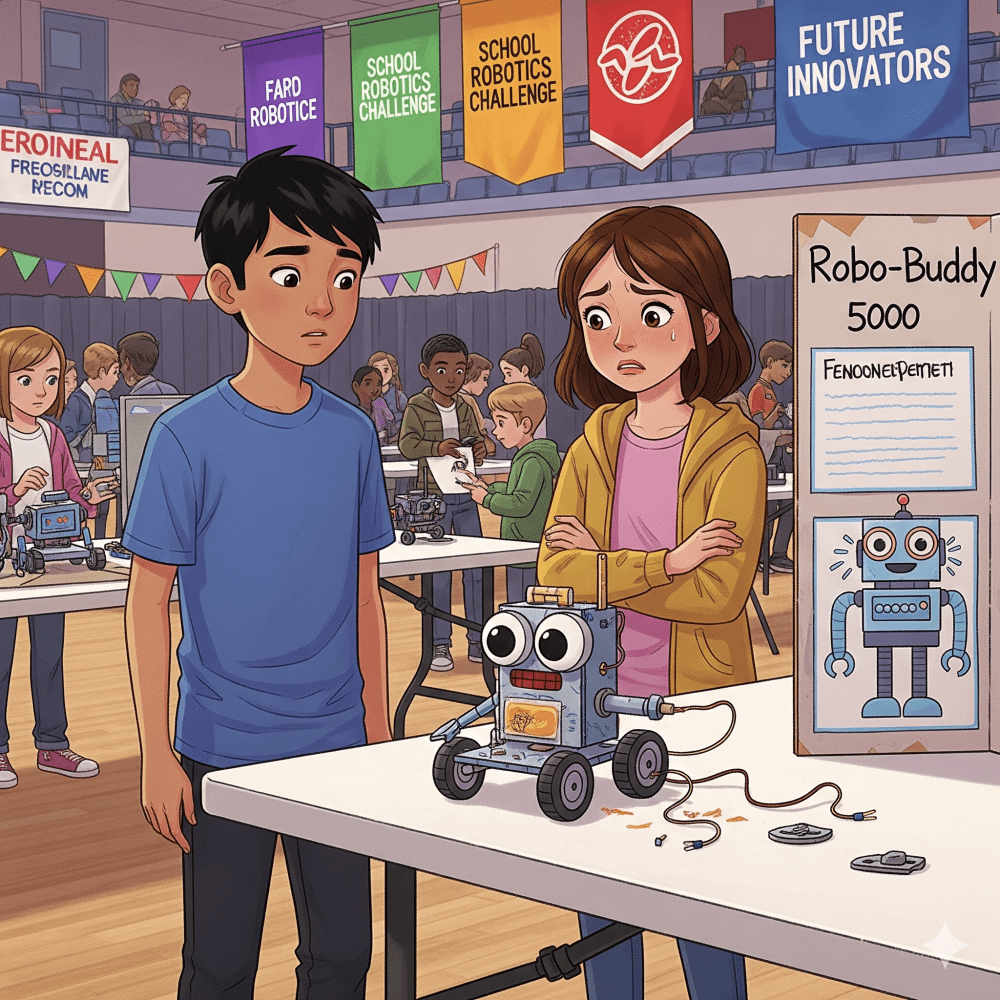
“It wasn’t supposed to fall!” he stammered. But the damage was done. Their project limped through the demo, and the judges quickly moved on.
Afterward, Sofia shook her head. “We worked for weeks. And now no one takes us seriously because of your stunts.”
Jake opened his mouth to argue, then shut it. For once, he didn’t have an excuse. Seeing the disappointment on his friends’ faces hurt more than any scolding.
That night, Jake lay in bed replaying the scene. He hadn’t meant to ruin things, but his constant need to add “fun” had cost his friends something important. For the first time, he wondered if maybe Marcus was right—maybe his trouble-magnet reputation wasn’t just bad luck. Maybe it was him.
The next morning, Jake showed up early to school. He helped Sofia reattach the robot’s arm, carefully following her directions instead of improvising. When Marcus arrived, Jake handed him a roll of tape. “I’m sticking to the boring jobs today,” he said with a sheepish smile.
Marcus grinned. “Good. We could use some boring.”
For the rest of the week, Jake focused on doing what was asked—no tricks, no surprises. It felt strange, but also kind of good. His friends started trusting him again.
Jake knew he’d always have a mischievous streak. But now he also knew something else: being the kid always in trouble wasn’t funny when it meant letting people down.
And that, more than any prank, stuck with him.
“The Trouble Magnet” by Nina D. Smith. Published by Bright Bunny Books © 2025. Retelling of “The Scapegrace’” from The Parkhurst Boys and Other Stories of School Life by Talbot Baines Reed, originally published in 1914.
“The Trouble Magnet” is best suited for grades 6–8 because it highlights common middle school struggles with responsibility, friendship, and learning from mistakes in a way that is both relatable and engaging.
Discussion Questions
- Why do you think Jake’s pranks went from funny to frustrating for his friends?
- How did the robotics showcase change the way Jake thought about his actions?
- What are some ways Jake could balance his playful personality with being more responsible?
This content is provided under fair use for educational purposes only. Commercial use is strictly prohibited by the creator.
 Bright Bunny Books