The room buzzed with quiet activity. Pages turned, pens tapped, and soft voices whispered review notes. Fluorescent lights hummed overhead as Ms. Reese walked to the front of the room and rang the small desk bell. It was a tradition from her years teaching elementary, but her tenth-grade students respected it enough to respond.
“Spelling review,” she said. “Row two, let’s go.”
A group of students moved to the whiteboard, most of them sliding into place with practiced ease. Eleanor Dallas rose last. She adjusted the sleeve of her sweater and followed, careful not to make eye contact.
It was her first day at a public high school. Until now, she’d always been homeschooled. She knew how to study. She knew how to read and write and do long division. What she didn’t know was how to walk into a room and not feel like everyone was staring.
Ms. Reese gave the first word: “Conscience.”
A girl with black braids wrote it quickly. The next word: “Separate.” A boy in a sweatshirt got that one, too.
“Eleanor,” Ms. Reese said gently, “your word is ‘parallel.’”
Eleanor froze. She’d studied this list last night, but now her mind filled with static. Her voice was barely audible. “P-A-R…”
“Louder, please,” said Ms. Reese, still kind.
Eleanor tried again, but her voice cracked mid-word, and her hand shook. She forgot if there was one L or two. Behind her, someone chuckled.
Ms. Reese stepped in before it got worse. “That’s fine for now, Eleanor. You’ll have some time to get used to the format.”
Eleanor wanted to disappear.
She returned to her seat, face burning. She’d overheard a whisper behind her—something like, “Yikes. Homeschooled much?” She kept her eyes locked on her notebook. The rest of class passed in a blur.
When the bell rang, Eleanor lingered. Ms. Reese looked up from her desk.
“Eleanor? Could you stay for a minute?”
Eleanor hesitated. Being asked to stay after class already felt like a failure.
Ms. Reese smiled and gestured to an empty desk near hers. “Come sit. I just want to go over tomorrow’s assignment with you. It’s not punishment.”
Eleanor sat slowly.
“Your mom said you’ve been studying different materials. Let’s get you caught up.”
Ms. Reese opened a new textbook and slid it toward her. “You can write your name in here.”
Eleanor nodded. “Thanks.”
They went over the next day’s lesson. It wasn’t hard, just unfamiliar. By the time they finished, Eleanor’s shoulders had dropped an inch.
As she was packing up, Ms. Reese looked at her. “You know, everyone feels like an outsider at some point. It passes.”
Eleanor didn’t answer, but something in her eyes softened.
The next day, things didn’t magically improve—but they weren’t worse.
She spelled “conscience” correctly. No one laughed. She didn’t say much at lunch, but she sat near people this time. Someone asked to borrow a pen.
On Thursday, in science class, Ms. Reese was leading a demonstration on static electricity. “I need a volunteer.”
A few students looked away. Eleanor didn’t raise her hand, but Ms. Reese glanced at her.
“Eleanor?”
She hesitated, then stood.
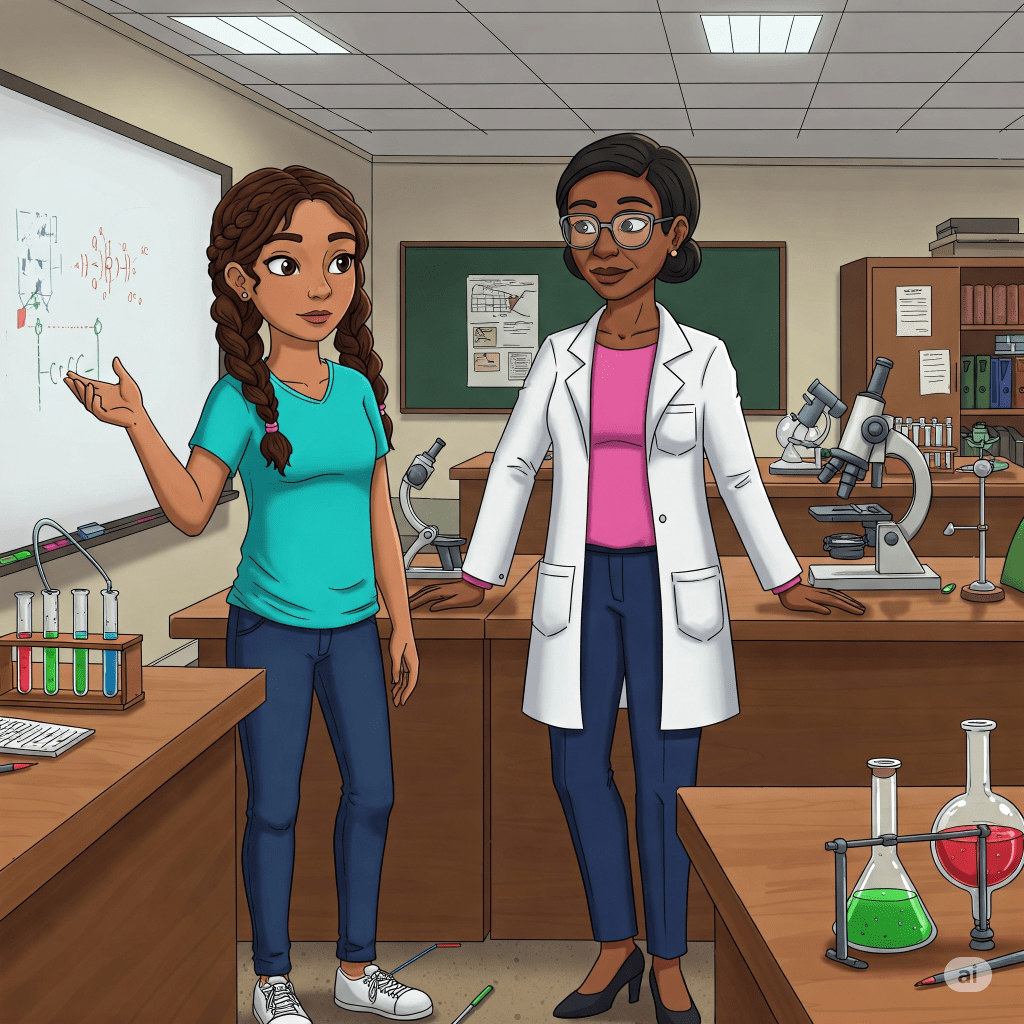
The experiment involved standing on a rubber mat and touching a metal rod connected to a Van de Graaff generator. It was supposed to be funny—hair rising from your head, small shocks. Eleanor’s fingers tingled as her hair slowly lifted. The class laughed.
She laughed too, but her eyes flicked around the room, unsure if they were laughing with her or at her.
Someone whispered, “It’s the ghost of homeschool past,” and a few more students laughed.
Eleanor stepped down from the mat and walked quickly back to her seat.
At the end of class, a girl named Jamie from her biology lab caught up to her.
“Hey,” Jamie said. “That was kind of weird, huh?”
Eleanor gave a half-smile. “Yeah.”
“Still. Brave of you. I wasn’t going up there.”
Eleanor didn’t say anything for a moment. “I thought it might help.”
Jamie shrugged. “It kind of did.”
They walked to the lockers in silence. Eleanor wasn’t sure if Jamie meant that as a compliment, but it didn’t really matter. She didn’t feel proud, but she didn’t feel invisible either.
She was starting to understand that being new didn’t mean you had to stay small forever—but it also didn’t mean people would make space for you. You had to claim it.
And that, she realized, would take more than a spelling list or a science demo.
“The Space Between Desks” by Bright Bunny Books © 2025. A retelling of “The New Scholar” from Dimple Dallas The Further Fortunes of a Sweet Little Maid by Amy E. Blanchard originally published in 1900.
“The Space Between Desks” is intended for students in grades 8–10, offering a realistic, emotionally nuanced look at transitioning into high school and finding one’s voice in a new social environment.
 Bright Bunny Books