Abdul Karim lived in a small valley with his wife, Zeeba, and their two children, Yusuf and Fatima. Their home was surrounded by fruit trees—peach, mulberry, and grape vines that made the air smell sweet in summer.
Abdul worked hard every day helping in the fields. He usually earned enough to keep his family comfortable, but one afternoon something special happened. His employer was so pleased with his work that he gave him a bonus of ten silver coins.
Abdul hurried home. “Look, Zeeba,” he said, laying the coins on the table. “A reward for good work!”
“What should we do with it?” he asked.
Zeeba smiled. “A piece of silk for a new dress would be wonderful.”
“I want a toy horse,” said Yusuf.
“And I’d like a colorful scarf,” added Fatima.
“You shall have them,” Abdul promised. The next morning, he set off for the city.
The city was buzzing with life—shops filled with fruits, sweets, and brass pots. The air smelled of fresh bread. Abdul had never seen so many things for sale in one place.
He stopped at a silk shop and admired a purple cloth with golden threads. “How much is this?” he asked.
“Two hundred coins,” said the merchant proudly.
Abdul’s smile faded. He only had ten coins. “I hoped to buy silk, a toy horse, and a scarf. But that’s far more than I can pay.”
The merchant shook his head. “Then you must look elsewhere.”
At every shop, it was the same story. Everything cost far more than he could afford. Disappointed, Abdul left the city empty-handed.
On the road home, Abdul noticed a tired man sitting under a tree. His clothes were dusty from travel, and he looked faint with hunger.
“Good sir, might you spare something?” the man asked softly.
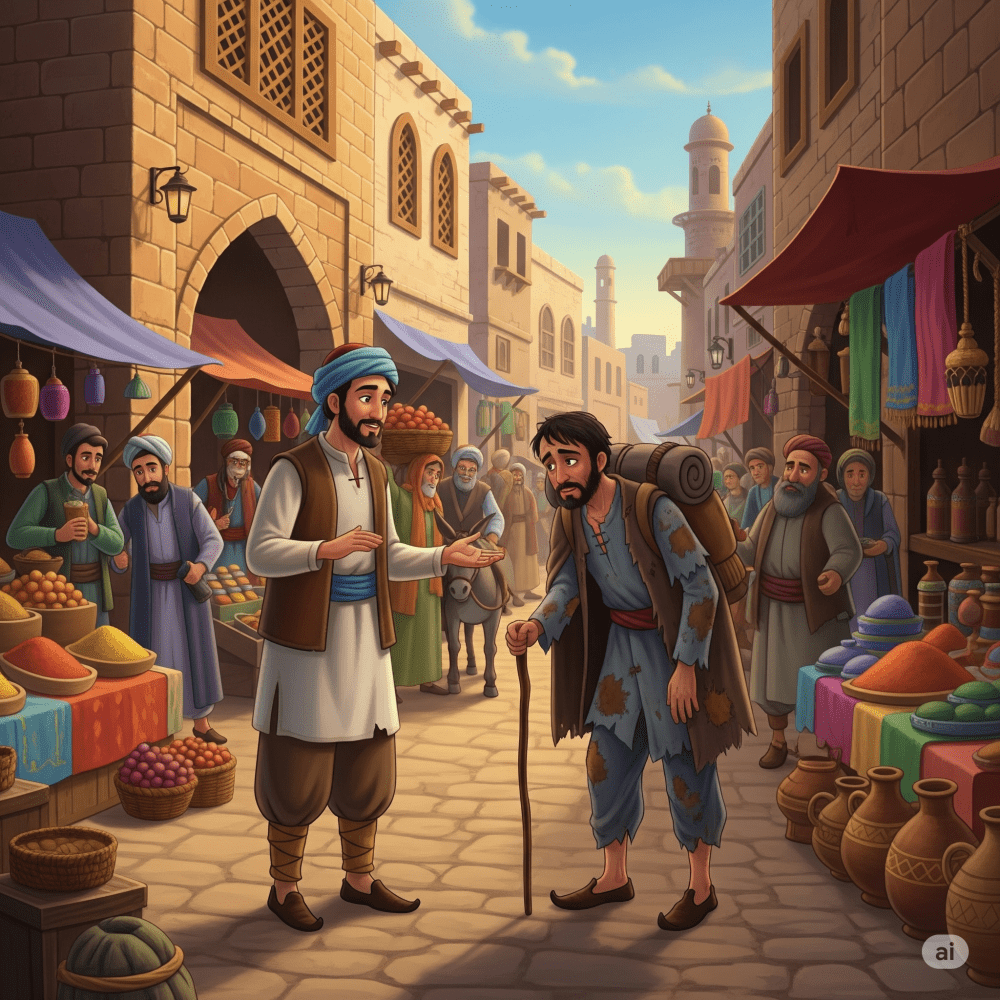
Abdul pressed the last of his coins into his hand. “Take these,” he said. “Use them for food and shelter. My family will understand.”
The man bowed deeply. “You do not know me, but I serve in the King’s court. Your kindness will not be forgotten.”
Weeks later, while digging a well, Abdul’s shovel struck something hard. He uncovered a brass jar filled with sparkling stones. Thinking they might be colored glass, he carried a handful to the city.
The jeweler gasped. “These are the King’s jewels! They were lost long ago.”
Word spread quickly, and soon soldiers brought Abdul and his family before the King.
Abdul trembled as the King looked down at him. But then the man he had helped on the road stepped forward.
“Your Majesty,” said the traveler, “this is the man who gave me his last coins when I was hungry. He expected nothing in return.”
The King’s eyes softened. “So you are the one who showed kindness to my messenger. These jewels do indeed belong to the crown—but today, because of your generosity, I give them to you and your family.”
Abdul bowed low. “Thank you, Your Majesty. I will use this gift wisely.”
The King smiled. “Let it be known in this land: true treasure is not what you find, but what you give.”
And so Abdul returned home with his family, not just with treasure, but with honor—proof that even the smallest act of kindness can reach the highest places.
“The King’s Treasure” by Nina D. Smith, published by Bright Bunny Books © 2025. Retelling of “The King’s Treasure” from Persian Fairy Tales by Hartwell James, originally published in 1906.
“The King’s Treasure” is perfect for grades 3–5. The clear language, simple plot, and moral lesson about kindness and fairness make it engaging and easy to understand for upper elementary readers.
Here are three discussion questions you could use:
- Why did Abdul choose to give away his last coins, even though he wanted to buy gifts for his family?
- How did Abdul’s kindness to a stranger affect what happened later in the story?
- What lesson do you think the King wanted others to learn when he said, “True treasure is not what you find, but what you give”?
This content is provided under fair use for educational purposes only. Commercial use is strictly prohibited by the creator.
 Bright Bunny Books