On summer afternoons, when the heat pushes everyone inside, I sit in a shady chair on the back porch and watch the bird families living in the giant boxwood bushes beside the brick path. The bushes are so thick and tall, they look like green apartment buildings. My mom calls them “the Boxwood Apartments,” and now I do too.
The top branches belong to a noisy family of robins. They flap in and out like they’re in a rush, always carrying worms. The middle floor is home to a thrush family, quieter and more polite. And on the ground level? That’s where the catbirds live, and they are the loudest of all. If anyone flies too close to their nest, they screech like someone left a violin in a blender.
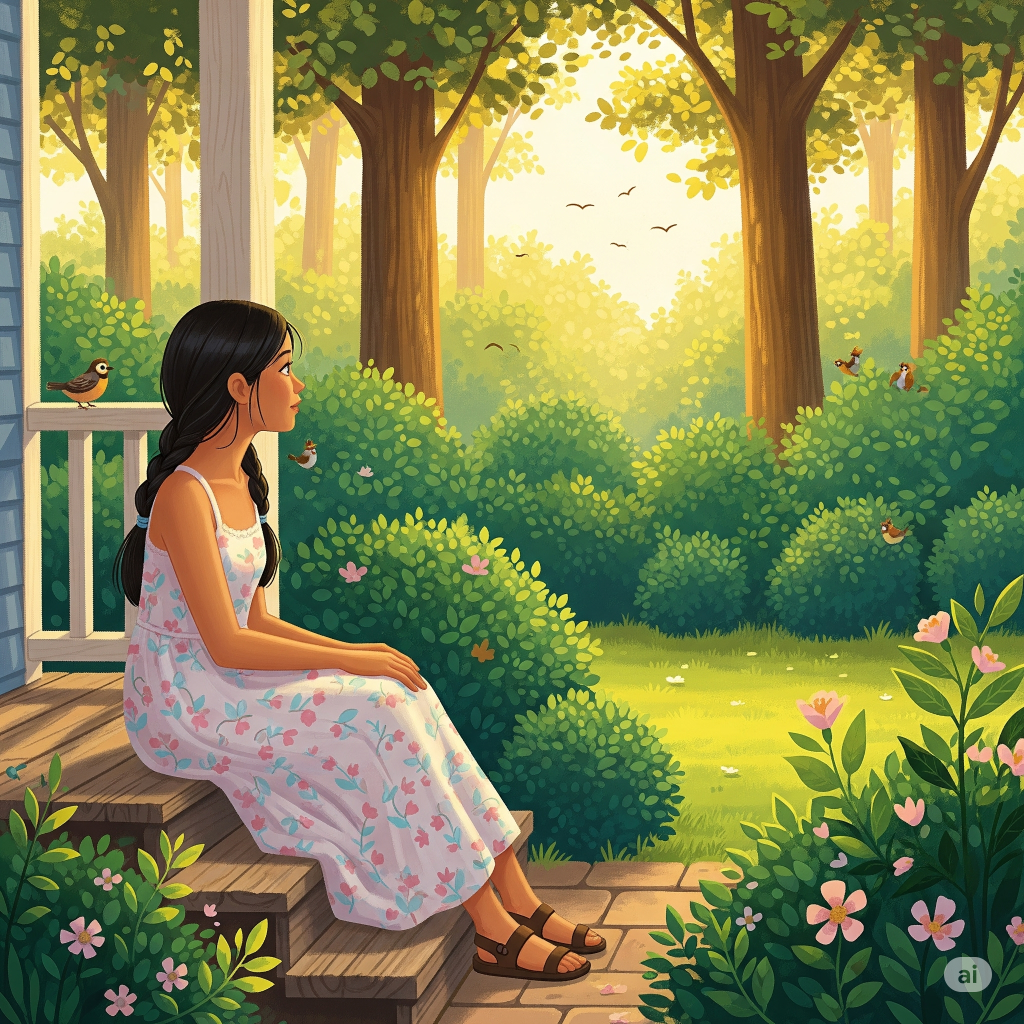
It’s like watching a whole neighborhood in fast forward. The robins never stop working. Their babies squawk so loud, I wonder how they have any voice left. The thrushes are more careful, especially around our dog, Ollie. Every time he trots across the grass, they dive in front of him like tiny feathery stunt doubles, pretending to be hurt just to lure him away from their nest. Ollie falls for it every time, running in circles while the thrushes fly off behind his back.
I’ve started keeping a notebook, writing down what I see. Birdwatching used to sound like something only old people did, but now it feels like I’m in on a secret. If you sit still long enough, the birds stop treating you like a stranger. They fly closer, watching you the same way you’re watching them.
One evening, after a big storm, I found a baby robin on the ground—just a ball of fluff with tiny wings. It squeaked up at me like it was asking for help. I didn’t know what to do, so I backed away and watched from the porch. A few minutes later, its parents swooped down, chirping like mad, and guided it back to a low branch. They didn’t yell at it or scold it. They just waited nearby, cheering it on with soft whistles until it made the jump. That stuck with me.
The best part of the day is right before sunset, when the shadows stretch long and the air cools down. That’s when the flying lessons begin. All the young birds wobble out onto branches, fluff puffed up like they’re wearing too many layers. Their parents coax them forward, hopping from tree to tree like, “Come on, you can do it.” Sometimes the babies flap and fall, landing in the bushes below with a thud—but they always get up again. It’s clumsy and a little chaotic, but it’s kind of amazing too.
There’s also a pair of doves living high in the tree at the corner of the yard. They’re the opposite of the catbirds—soft-spoken and gentle. All day, I hear them cooing at each other like they’re stuck in an endless love song. Their nest looks like it was built in five minutes, barely holding together. I keep expecting it to fall apart after every rain, but it hasn’t yet. Maybe love really is the glue.
And then there are the hummingbirds. Fast, flashy, and fierce. I used to think they were all sweetness and light, but they’re like little flying swords. I saw two of them fight once—zipping through the air and jabbing with those needle-like beaks. One flew off, and the other circled back like it had just won a trophy. Still, when they hover near the trumpet vine, drinking nectar, they look like something out of a dream—tiny rainbows with wings.
Every night, after the birds settle down, a single call echoes up from the woods beyond the backyard: the whip-poor-will. I’ve never seen him, but I know he’s out there, singing the same sad song on repeat. He doesn’t come close like the others. He just keeps his rhythm while the rest of the yard sleeps.
As I sit out there, my notebook in my lap and Ollie snoring at my feet, I feel like I’m part of something bigger. The birds don’t know my name, but they know I’m not a threat. I’m just the kid on the porch, writing things down, trying to understand the rules of their world.
And maybe, just maybe, they’re starting to understand me too.
“The Boxwood Apartments” by Bright Bunny Books © 2025. Retelling of “The Boxwood Flats” from The Old House and Other Stories by Blanche Sellers Ortmann, originally published in 1910.
“The Boxwood Apartments” is best suited for upper elementary to middle school students, particularly those in grades 6–7 due to its reflective tone, descriptive language, and relatable themes of observation and quiet growth.
 Bright Bunny Books