Noah was the kind of kid everyone liked—and the kind who could turn a simple job into a small disaster. He didn’t mean to. He rushed, guessed, and hoped for the best. It almost worked. Almost.
His best friend Eli teased him kindly. “You’re ninety percent genius and ten percent whoops.”
Mr. Patel, their technology teacher, had learned to give Noah very clear directions. “Slow is smooth, smooth is fast,” he’d say, handing over tasks one step at a time.
On Monday, Mr. Patel announced, “Our class will demo the recycling app at Friday’s showcase. Eli, you’ll present. Noah, you’ll handle logistics: print the handouts, label the bins, and bring the tablet with the latest build.”
Noah saluted. “On it.”
The week raced by in a blur of almost-finished things. Noah printed handouts but left them on the library printer. He labeled the collection bins, but two labels peeled off and stuck to each other. He even updated the app—except he updated it on the wrong tablet.
“It’s fine,” he told Eli. “I’ll fix everything before homeroom Friday.”
Eli raised an eyebrow. “Please actually fix it.”
Friday came with the speed of a notification ping. Noah sprinted into the gym five minutes before the showcase. His backpack bulged with papers, chargers, and a banana he’d forgotten to eat. Mr. Patel was setting out name tags. Eli straightened the poster board.
“Handouts?” he asked.
“Right here,” Noah said triumphantly, pulling out a thick stack—only to realize they were the older draft with the broken QR code. He swallowed. “I’ll reprint.”
“And the app?” Mr. Patel asked.
Noah powered on the tablet. The icon opened to last month’s version. The “Submit” button, the whole point of the demo, wasn’t there yet.
Visitors began drifting in. Music echoed. The principal waved. Eli looked at Noah, not angry—just disappointed.
Noah’s stomach dropped. He’d always laughed off his mistakes as “close enough,” but now he wasn’t just almost right—he was letting people down.
Mr. Patel stepped closer, voice low. “You have two choices. Keep guessing and hope, or slow down and fix one thing at a time. Which will it be?”
Noah took a breath. “Slow down.”
“Good,” Mr. Patel said. “Pick the first fix that helps the audience.”
“Handouts,” Eli said. “People need to follow along.”
Noah nodded. He jogged—no sprinting this time—to the library, reprinted the correct file, and counted each set as it slid out. Back in the gym, he handed stacks to Eli, who passed them down the rows.
“Next?” he asked.
“Labels,” Eli said.
He pressed fresh tape over the bin signs and ran a quick check: paper, plastic, metal, e-waste. Nothing peeling, nothing crooked.
“App,” Mr. Patel said.
Noah opened the tablet’s settings and realized the obvious: he was on the school’s old tablet. The updated one sat in his backpack—under the banana. He swapped devices, wiped the smear off the screen, and opened the app. The new “Submit” button glowed like a green light.
They made it to the starting line with seconds to spare.
Eli began, steady and clear. “Our app helps students sort recycling. Scan, sort, submit.” He held up the tablet. “Noah, hit submit?”
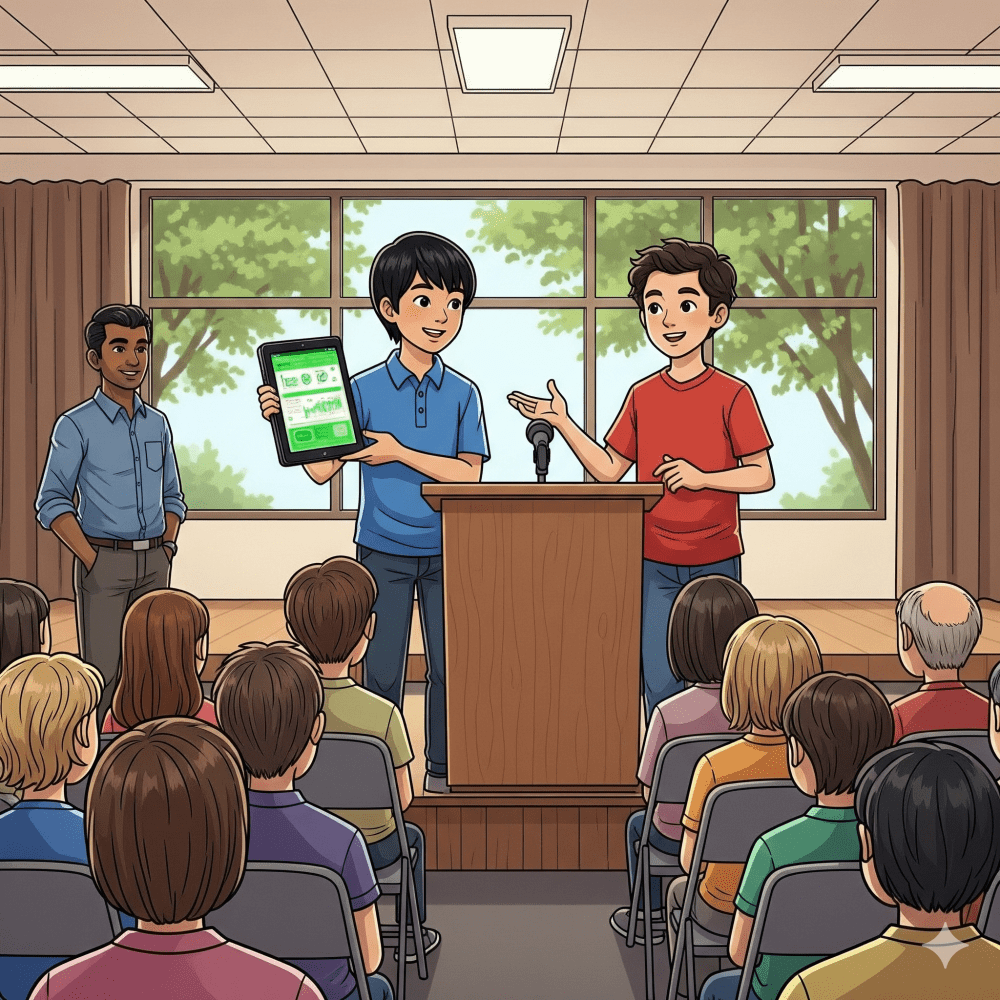
He tapped. The app chirped and sent a tiny confetti animation across the screen. The crowd laughed and clapped. The demo worked. Not perfect—there was a slight lag—but it worked. People lined up to try it, and the bins filled in neat layers.
Afterward, Eli bumped Noah’s shoulder. “That was close.”
“Too close,” Noah said. “I’m done with ‘almost.’”
Mr. Patel handed Noah a sticky note. “Write your checklist for next time. Three items.”
Noah wrote: Print final. Verify labels. Confirm device. He stuck it on the inside cover of his notebook.
Walking out of the gym, Noah felt lighter. He hadn’t become a different person in one morning. He still thought fast and moved faster. But he’d learned something bigger than any code trick: thinking first beats fixing later.
On Monday, Mr. Patel announced a new event. “We’ll run our demo for the fifth graders.”
Eli looked at Noah.
He patted his notebook. “Already printed. Already labeled. Already updated.”
Eli grinned. “Ninety percent genius?”
“No,” Noah said, smiling. “One hundred percent ready.”
“The Almost-Right Kid” by Nina D. Smith. Published by Bright Bunny Books © 2025. Retelling of “The Duffer” from The Parkhurst Boys and Other Stories of School Life by Talbot Baines Reed, originally published in 1914.
“The Almost-Right Kid” s ideal for grades 6–8 because it highlights responsibility, teamwork, and personal growth in a relatable school setting, encouraging students to reflect on their own habits and choices.
Discussion Questions
- Why do you think Noah kept making mistakes, even when he wanted to do well?
- How did Mr. Patel and Eli help Noah change the way he approached problems?
- What strategies could you use in your own schoolwork or activities to avoid being “almost right” and instead be fully prepared?
This content is provided under fair use for educational purposes only. Commercial use is strictly prohibited by the creator.
 Bright Bunny Books