Once there was a kind old farmer and his wife who lived near the woods. They spent their days growing vegetables and rice in the fields. But every night, a mischievous badger snuck into the garden and ruined their hard work. He dug up the plants, knocked over water buckets, and made a mess.
The farmer tried to stop him. He stayed up late with a flashlight. He even set a few traps. One morning, he found the badger caught in a deep hole lined with soft rope.
“I’ve got you at last!” said the farmer. He carefully tied the badger and brought him home. “Watch him while I work,” he told his wife. “We’ll take him far from the farm later so he can’t bother us anymore.”
The farmer went back to the fields. His wife kept an eye on the badger, who was tied up and resting in the shed.
After a while, the badger said softly, “You look tired, ma’am. I feel bad just lying here while you do all the work. If you untie me, I can help you grind barley. I’m strong, and I promise I won’t run away.”
The woman wasn’t sure. “I’m not supposed to untie you,” she said. “But… I guess it would be nice to rest for a bit.”
The badger smiled. “I’ll be quick. I’ll even let you tie me back up when we’re done.”
Trusting his promise, the woman untied the ropes and gave him the heavy pestle to pound the barley.
But the badger didn’t help. Instead, he dropped the tool, ran outside, and disappeared into the forest.
When the farmer came home and heard what had happened, he was disappointed but not angry. “It’s not your fault,” he told his wife. “The badger tricked you. I’m just glad you’re okay.”
Not far away, a clever rabbit lived in the same forest. When he heard the story, he wanted to help.
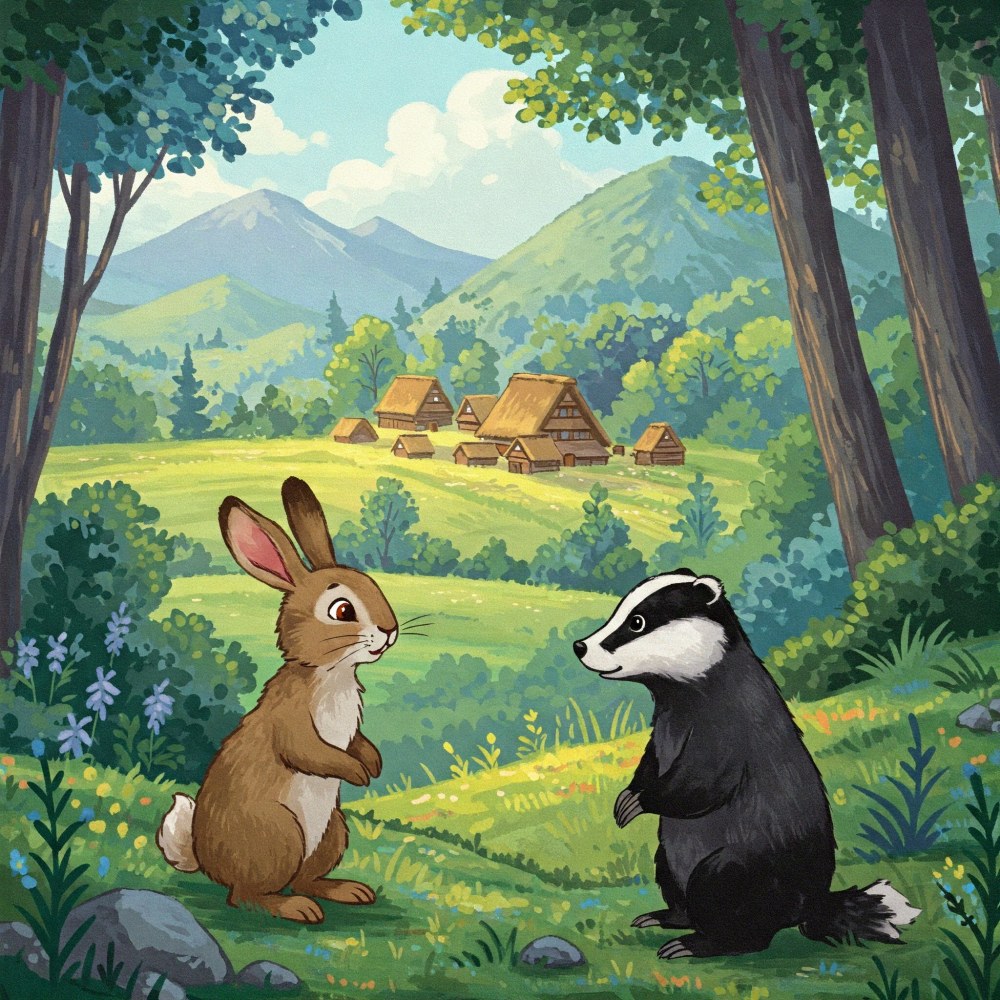
“That badger needs to learn that causing trouble has consequences,” the rabbit said. “Let me handle this.”
The next day, the rabbit visited the badger. “Hey,” he said cheerfully, “want to come with me to collect grass for the winter?”
The badger, thinking the rabbit was a friend, agreed. They went to the hills and gathered big bundles of dry grass.
“Let’s carry them home,” the rabbit said. “You lead the way!”
As they walked, the rabbit quietly placed small sparks under the badger’s bundle using two stones. The grass began to smoke and crackle.
“What’s that sound?” asked the badger.
“Oh,” said the rabbit, “this mountain is called Crackle Hill. It always makes that sound.”
Soon, the badger’s bundle grew warm and smoky. “Why does it smell like something’s burning?”
“We just passed Burn Hill,” said the rabbit. “It always smells like that.”
By the time the badger realized what was happening, it was too late. His bundle of grass had burned away, leaving him embarrassed and itchy from the smoke.
He ran home, coughing and upset. The rabbit followed him with a bottle of cooling lotion.
“Let me help,” the rabbit said. “This will make you feel better.”
The rabbit dabbed a small amount on the badger’s back. It stung at first—just a little—but it helped the badger cool down. The badger grumbled but didn’t say much.
A few days later, the rabbit invited the badger to go boating. He gave the badger a clay boat and kept a wooden one for himself.
They paddled out into the river, but soon the clay boat began to sink. “Help!” cried the badger.
The rabbit said, “You played tricks on others. Now you know what that feels like.”
The badger swam to shore, soggy and embarrassed, but safe. He never bothered the farmer’s garden again.
The rabbit told the farmer what happened. The farmer and his wife thanked him, and from that day on, the rabbit visited often. They became good friends and enjoyed peaceful days together.
“The Farmer and the Badger” by Nina D. Smith © 2025. Retelling of “THE FARMER AND THE BADGER” from Japanese Fairy Tales by Yei Theodora Ozaki originally published in 1908.
Did you enjoy this story? Read this poem next: The Warmest Thing
This story is best suited for students in grades 3–5, as it uses accessible language, features animal characters with clear moral lessons, and explores themes of trust, consequences, and clever problem-solving.
 Bright Bunny Books