Jules had only been in town three days, and she still wasn’t sure what to make of it.
She leaned against the railing of her cousin Mateo’s porch, watching the late afternoon sun turn the sky orange. Somewhere down the street, someone was playing jazz on a trumpet. It echoed between the houses, smooth and low, mixing with the scent of jasmine.
“I don’t get it,” Jules said, turning to Mateo. “Why does everyone hang out outside? It’s like nobody in this town ever goes inside unless it’s bedtime.”
Mateo, lounging in a woven chair with his shoes kicked off, smiled. “Because why would we? This city’s basically one giant living room. And the best part is, everyone’s invited.”
Jules crossed her arms. “I’m just saying… back home, we liked our air-conditioning. And space.”
“You had snow,” Mateo pointed out. “It’s barely spring here, and we’ve already had three picnics.”
She couldn’t argue with that.
Down the block, two kids zipped past on scooters, laughing. Across the street, a woman watered her porch plants while chatting with the neighbor next door, who was grilling something that smelled amazing.
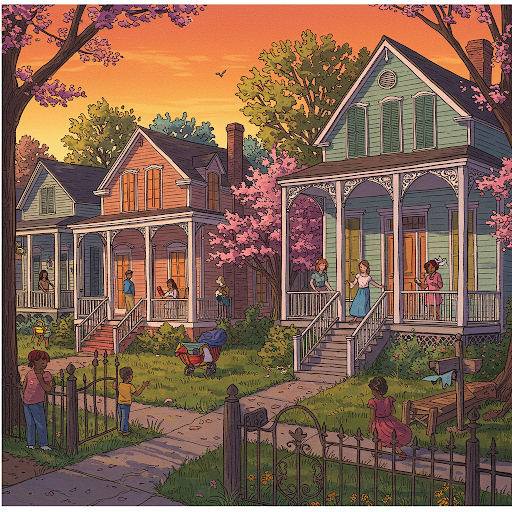
“You want to know a secret?” Mateo said, standing up and stretching. “Nobody here minds being seen, because we’re not really watching each other. We’re just… part of the same picture. Everyone’s outside, so no one feels weird about it.”
Jules raised an eyebrow. “Sounds like you read that on a postcard.”
He grinned. “You just pick it up after living here long enough.”
Later that evening, they walked to the corner café. It was the kind of place where the walls rolled up like garage doors so that half the seating was outdoors. String lights crisscrossed above the tables, and a local band was setting up on the tiny stage near the sidewalk.
Jules hesitated at the entrance.
“What?” Mateo asked.
Jules shrugged. “I don’t know. I feel like everyone here already knows each other. Like I’m the outsider crashing someone’s backyard party.”
“You’re not,” Mateo said. “You just haven’t been introduced yet.”
As they waited in line, a girl behind them smiled and said, “You’re new, right?”
“Yeah,” Jules replied, surprised. “Just moved in with my aunt.”
“Cool. Welcome. I’m Maya,” she said. “You should totally come to porch night tomorrow.”
“Porch night?” Jules asked.
“You’ll see,” Maya said with a grin.
They took their food to a picnic table under a giant oak tree. Fireflies blinked in the distance, and the trumpet player from earlier had moved closer, his case open on the sidewalk for tips. A group of kids danced in front of him while their parents clapped along.
“This is weird,” Jules admitted between bites. “But kind of great?”
Mateo smiled without saying anything.
The next morning, Jules sat on the front porch with a sketchpad balanced on her knees. She drew the scene in front of her—the wisteria hanging from the fence, the cat sleeping on the warm sidewalk, the street full of life.
She didn’t realize how long she’d been out there until a boy from two doors down walked by and waved.
“Hey,” he said. “You coming to porch night later?”
“What exactly is porch night?”
“Everyone brings snacks and hangs out,” he said. “Some people bring guitars. Sometimes people read stuff or tell stories. It’s just a thing we do on Fridays.”
Jules glanced down at her sketchpad. The sun had shifted, casting soft shadows on the porch.
“Yeah,” she said. “I think I will.”
“The City that Lives Outdoors” by Nina. D Smith © 2025. Retelling of THE CITY THAT LIVES OUTDOORS by W. S. Harwood, originally published in Southern Stories Retold from St. Nicholas, 1889.
 Bright Bunny Books