The kitchen was warm and filled with the smell of garlic, ginger, and simmering broth. Jordan stood at the stove, watching the sauce bubble. His cousin Tessa, home from college for the weekend, was chopping cilantro at the counter.
“So,” she said, glancing at him, “you’re officially in charge of the family fish stew now.”
Jordan raised an eyebrow. “I thought you were in charge.”
“I’m supervising,” she said with a grin. “You’re cooking.”
He stirred the pot carefully. “This better turn out okay. Uncle Ray still talks about the time I burned the rice at Thanksgiving.”
Tessa laughed. “Yeah, that was impressive. But don’t worry. This recipe’s harder to mess up.”
Jordan didn’t laugh. He sighed instead. “Feels like people only remember the stuff I do wrong.”
Tessa looked over. “Something happen?”
Jordan shrugged. “I mean, yeah. I helped Coach set up all the cones this morning and stayed after to clean up. But when we did drills, he still called me out in front of everyone like I was slacking.”
“Maybe he didn’t notice the other stuff.”
“Exactly. That’s the problem. When someone else makes a mistake, people forget. But with me? It sticks. Like one bad move and it’s who I am forever.”
Tessa slid the chopped cilantro into a bowl. “You ever heard that idea about people carrying two backpacks?”
Jordan glanced over. “Is this another college metaphor?”
“Kind of. One of my professors said it’s like we all walk around with two invisible bags—one in front of us and one behind. The front one is filled with all the mistakes and flaws we see in other people. The one in the back holds our own mistakes.”
Jordan went back to stirring. “So… we just ignore the stuff in the back?”
“Usually, yeah. It’s easier to point out what someone else is doing wrong when you’re not looking at your own stuff. Not because we’re bad people—it’s just human nature.”
Jordan was quiet for a second. “I mean… I guess I did skip warm-ups last week. And yeah, I’ve been late to class a couple times.”
“There you go,” Tessa said. “That stuff doesn’t make you a bad person. But if you don’t think about it, you end up frustrated because you feel misunderstood—when maybe people are just reacting to what they’ve seen so far.”
He nodded slowly. “Okay, that makes sense.”
They stood in silence for a moment, listening to the sauce bubbling.
“You know what I like about cooking?” Tessa said. “You can mess up—use too much salt, leave the pot on too long—and still fix it. You just have to pay attention and adjust.”
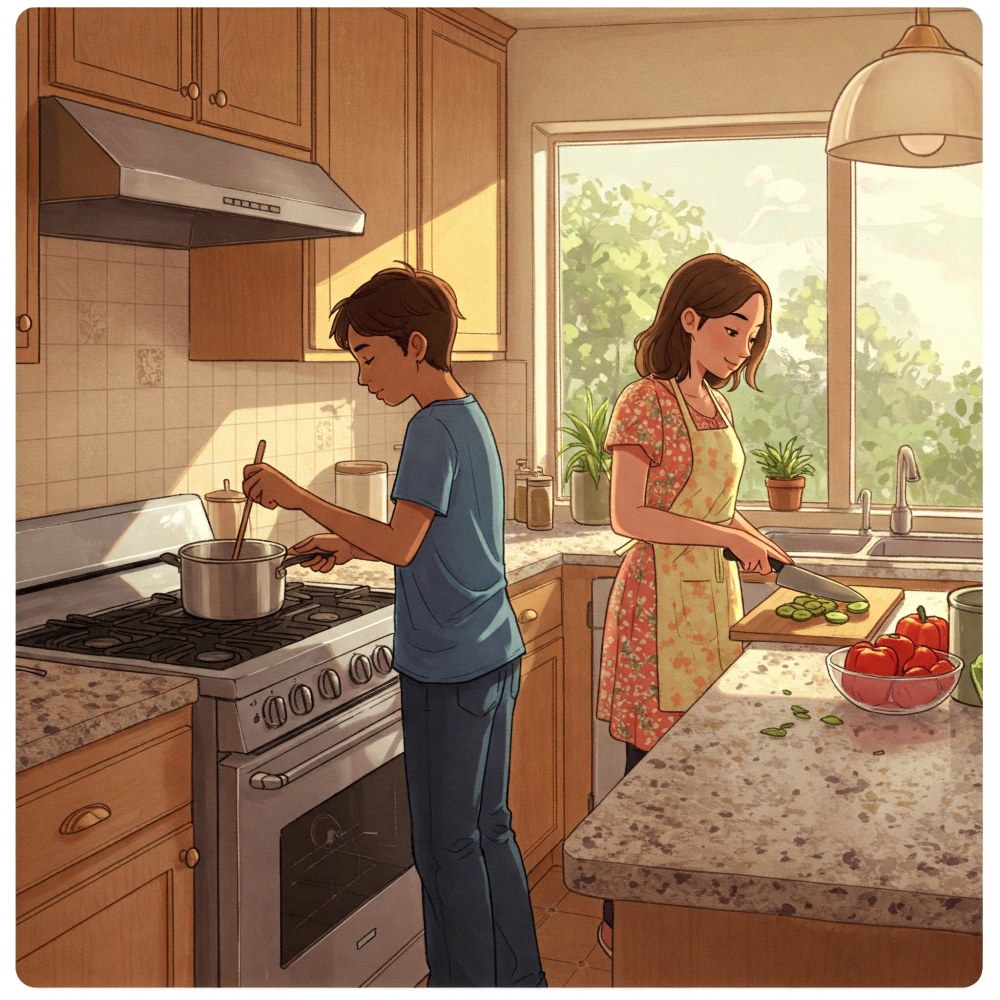
Jordan gave her a sideways glance. “You said this wasn’t going to be another metaphor.”
“It’s not,” she said. “But it’s true.”
He smiled in spite of himself. “So if I start doing better, people might start seeing me differently?”
“Probably not right away,” she said honestly. “But if you keep showing up and doing the work—yeah, over time, they will. Just don’t forget to check your own blind spots now and then.”
Jordan gave the pot one last stir, then took a spoonful to taste. “It’s actually good.”
“Of course it is,” Tessa said. “You’re better at this than you think.”
Jordan didn’t say anything, but he felt a little lighter—like he’d dropped something he hadn’t realized he was carrying.
“Stirring the Pot, Checking the Pack” by Nina D. Smith © 2025. A retelling of “The Two Wallets,” a tale by Aesop.
“Stirring the Pot, Checking the Pack” is appropriate for readers in grades 5 to 7, as it uses realistic dialogue, relatable family dynamics, and age-appropriate metaphors to explore self-awareness, personal growth, and how perceptions of fairness can shape middle school experiences.
 Bright Bunny Books