It was a warm Saturday in early September, and best friends Jade and Tasha walked down the cracked sidewalks of their neighborhood, kicking pebbles as they went.
“I still can’t believe we didn’t get picked,” Jade said, adjusting the strap of her backpack.
“Yeah,” Tasha replied. “Everyone else in the program got to go to that weekend farm trip. And we just didn’t.”
They were both part of a city youth club that offered free programs—homework help, art classes, and sometimes field trips. The farm visit was a special end-of-summer reward. Almost all their friends went, but somehow, Jade and Tasha’s names had been left off the list.
“We signed up on time,” Tasha grumbled. “Remember? I turned in both our forms.”
Jade nodded. “And we helped clean the rec room last month when no one else showed up.”
“It’s always like this,” Tasha muttered. “If you’re quiet, people forget you.”
They walked in silence for a bit, passing boarded-up buildings and corner stores. The breeze smelled like asphalt and car exhaust. Jade kicked a soda can into the gutter.
“Ugh,” she said. “I just wanted to see something green for once. Trees, grass—anything.”
They rounded the corner and saw the faded sign for their youth center: Maple Hill Community Hub. A volunteer named Ms. Dana stood outside by a folding table, setting out a stack of paper cups and two jugs of lemonade.
“There you two are,” she said. “I was just about to text your parents.”
Jade and Tasha looked at each other, confused. “Why?” Jade asked.
“I signed you up for today’s garden visit,” Ms. Dana said, smiling. “The trip to the city’s new urban farm. It’s not the big weekend thing, I know, but I figured you deserved something.”
Tasha’s eyes lit up. “Wait—seriously? Like an actual garden?”
“Yep. You’ll help out for a few hours, pick some vegetables, meet a few folks. And then there’s pizza.”
Fifteen minutes later, they were on a small bus with five other kids from the neighborhood. The ride was short, but the change in scenery felt huge. Rows of raised garden beds stretched across an old parking lot. Sunflowers leaned into the sky. Chickens clucked in a wire pen. A compost station sat near the back, buzzing with bees.
Jade and Tasha stepped off the bus slowly, looking around in awe.
“Okay, this is not what I expected,” Jade said, her voice quiet with wonder.
“I thought it’d be like three sad tomato plants,” Tasha whispered. “This is beautiful.”
They spent the afternoon helping in the garden. A woman in overalls named Miss Kiara showed them how to harvest green beans and rinse them gently with the hose. A man with a wide-brimmed hat taught them how to loosen carrots from the soil without snapping them. They even fed the chickens, laughing when one pecked at Tasha’s shoelace.
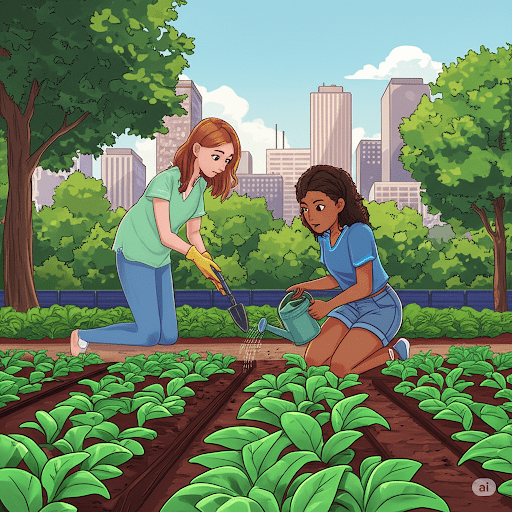
By late afternoon, their hands were dirty, their sneakers dusty, and their backpacks full of vegetables to take home.
The group sat under a shade tent, sipping lemonade and eating pizza. The air smelled like basil and soil.
“I feel like I can breathe here,” Jade said.
Tasha nodded. “It’s weird. It’s not the big farm trip, but it kind of feels better. Like this is ours.”
Jade looked out at the garden beds, watching bees bounce between marigolds. “I don’t even care that we didn’t get picked anymore.”
Tasha grinned. “Same. I’m just glad someone remembered us.”
Ms. Dana walked over, handing them each a small envelope. “By the way,” she said, “the garden staff loved having you today. If you want, there’s a Saturday volunteer spot open every month.”
The girls opened their envelopes and found hand-drawn thank-you cards and a photo of their group taken next to the tallest sunflower.
“We’re definitely coming back,” Jade said.
“No doubt,” Tasha agreed.
They rode home with the windows down, their bags full of vegetables, their minds full of color, and the city looking a little greener than before.
“A Day in the Garden” by Nina D. Smith © 2025. Retelling of “A DAY IN THE COUNTRY” from A Day in the Country and Other Stories from “The Pansy” originally published in 1885.
This story is best suited for students in grades 4–6, as it features relatable middle-grade characters, explores themes of fairness, belonging, and community, and uses accessible language and a realistic setting familiar to upper elementary readers.
 Bright Bunny Books