Maya zipped her coat and stepped onto the trail behind the cabin. The air smelled like pine and frost. Dried wildflowers lined the narrow path, but she didn’t notice. Her feet crunched over fallen leaves, but she didn’t hear.
She was too busy missing everything she’d left behind.
Six months ago, she lived in Boston—rushing through hallways, practicing piano, hanging out with friends. Then her mom got a new job working remotely, and they moved into Grandpa’s old cabin in the White Mountains “for a fresh start.”
Maya hadn’t asked for a fresh start. She wanted her old school, her city, her friends.
Now she was twelve and halfway through what felt like the longest fall of her life. The summer tourists were gone. Her one friend had moved away. Even the birds had vanished.
She missed people. Noise. Things to do. Even homework.
That morning, Maya had eaten breakfast in silence while her mom typed on her laptop and her older brother, Leo, scrolled through his phone. No one said much. The quiet pressed in.
“I’m going for a walk,” she had announced.
“You okay?” her mom asked without looking up.
“I just need some air.”
Now she hiked past the old fire road and ducked under a low pine branch. After another mile, the trail curved—and there it was. A quiet mountain lake, deep blue and still. She’d only seen it once in the summer, when the trail was crowded. Now it was completely empty.
She sat on a flat rock and stared across the water. Across the lake, near the top of the ridge, something caught her eye. A rocky cliff jutted out from the slope—and somehow, it looked like a face.
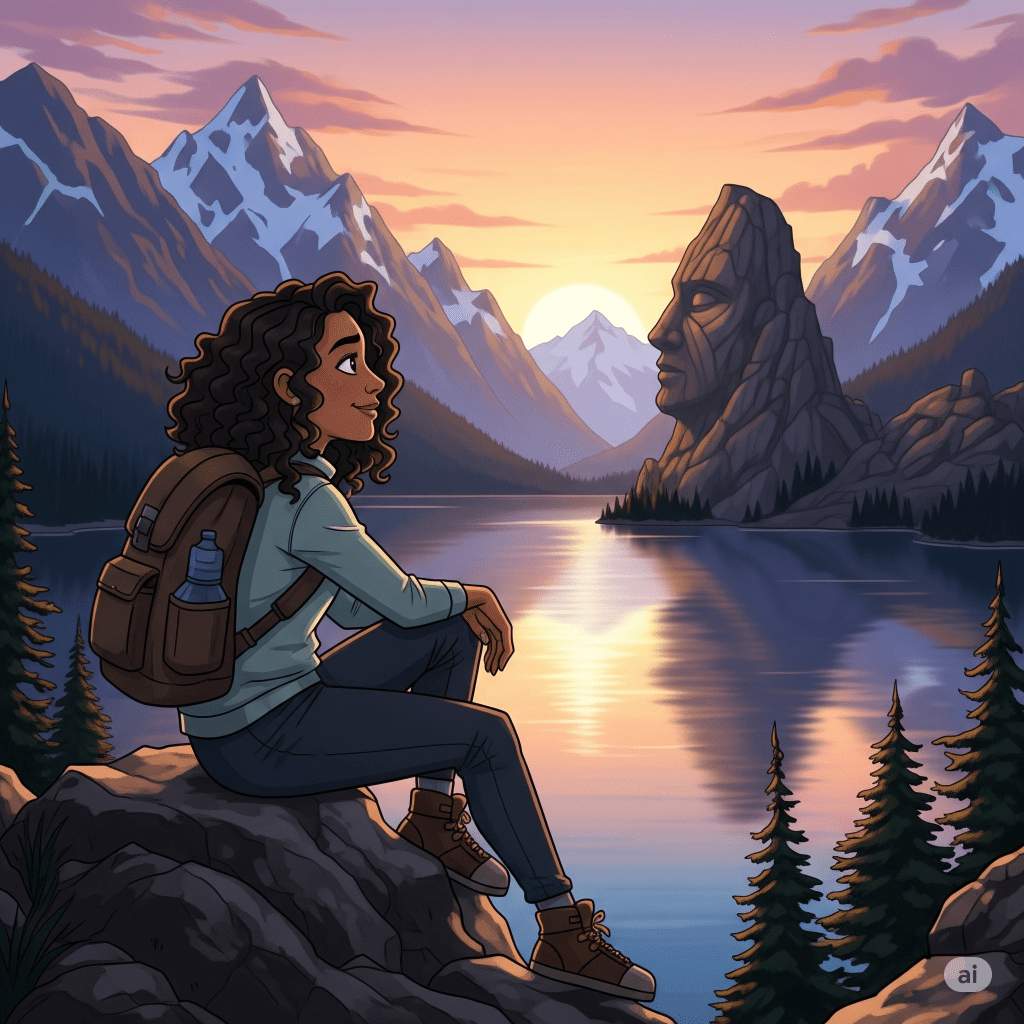
A profile, tilted slightly up. Strong jaw. Wide brow. Calm expression.
Maya blinked. She remembered her grandpa telling her about it once. “That’s Stoneface,” he’d said. “Some people say the mountain watches over the lake. Some say it listens.”
Now she stared at the face again. “If you were me,” she said quietly, “what would you do?”
The wind barely stirred. The trees didn’t answer. But something about the stone face felt steady. Not just old—but patient.
“If you were twelve, and your whole life got picked up and moved without asking you. If you had to leave everything behind—your school, your best friend, your music—what would you do?”
The stone didn’t speak, of course. But Maya kept talking.
“I want to go back,” she whispered. “I want to feel like myself again.”
The silence didn’t feel so heavy anymore. She pulled out her sandwich and ate slowly, watching the water reflect the sky.
As she chewed, she thought about last week, when Leo let her pick the movie, even though he said it was “cheesy.” Or the way Mom set up her piano keyboard in the corner of the cabin—even if it took up half the room. Or the postcard Maya had gotten in the mail from her friend Zoë, with a sketch of a squirrel on it and a note that said: I miss your sarcasm. Write back soon.
Maya stood and stretched. Her legs were stiff from sitting on the cold rock. She looked one last time at the mountain’s face across the lake.
“I don’t know how to fix everything,” she said. “But I guess I can start with what I’ve got.”
She unwrapped the last piece of her cookie and left it on the rock—just in case a chipmunk wandered by—then turned back toward the trail.
As she walked, she noticed how the frost sparkled on the dried leaves. A chickadee chirped from a branch above, and she chirped back.
By the time she reached the cabin, the sky was turning gold and orange. Her mom stood on the porch with a mug of tea.
“Good hike?” she called.
Maya nodded. “Yeah. Better than I expected.”
She smiled and looked over her shoulder one last time, toward Stoneface Lake. She couldn’t see the cliff from here—but she didn’t need to.
She could still feel it.
“Stoneface Lake” by Nina D. Smith. Published by Bright Bunny Books © 2025. Retelling of “I Would Be True” from Fireside Stories for Girls in Their Teens by Margaret W. Eggleston, originally published in 1921.
“Stoneface Lake” is ideal for middle school readers in grades 6–8, as it explores relatable themes of change, identity, and emotional resilience through a thoughtful, age-appropriate lens.
 Bright Bunny Books