I’ll be honest—I didn’t expect anything from this move. Mom said we needed a “fresh start,” but I knew the real reason: she couldn’t keep up with rent after Dad left. So we packed up our tiny apartment and headed out to live with some distant relatives I’d never met. Apparently, they had a big house in the countryside and enough room for “one more.”
My name’s Jay. I’m thirteen, and up until this fall, I lived in Chicago. Now I was moving into a place called Marlowe Ridge with people who barely knew I existed.
I remember the first time I saw the house. It was huge—like the kind of house you see in movies with secret passageways and rooms no one uses. It was covered in snow, too. A fresh storm had blanketed everything, and it was so quiet I could hear the crunch of my boots like thunder.
Uncle Dean and Aunt Molly greeted us at the door with warm smiles and awkward hugs. But the person who stuck out the most was Katie. She was my age, but she looked like she’d walked straight out of a retro snow globe: red coat, messy braid, and an attitude that didn’t match her perfect smile.
“Are you the cousin?” she asked, raising an eyebrow.
“I guess,” I said, shrugging.
She rolled her eyes. “Well, try not to mess anything up.”
The next few days were weird. The house felt too big and too quiet. I missed the buzz of the city, the noise outside my window, the corner store with stale candy and cheap sodas. Here, there was nothing but trees, snow, and a girl who made it clear she didn’t want a new roommate.
One afternoon, Katie was out in the backyard building something. I watched her from the window. She had packed the snow into perfect little blocks like bricks. After a few minutes, I slipped on my boots and joined her.
“What are you doing?” I asked.
“Making a snow fort,” she said without looking up. “I do it every winter. Usually alone.”
“I can help.”
She paused, then handed me a shovel. “Fine. But follow my design. No improvising.”
We worked side by side for over an hour. I didn’t say much. Neither did she. But somehow, it was the first time since I’d arrived that I felt like I wasn’t completely invisible.
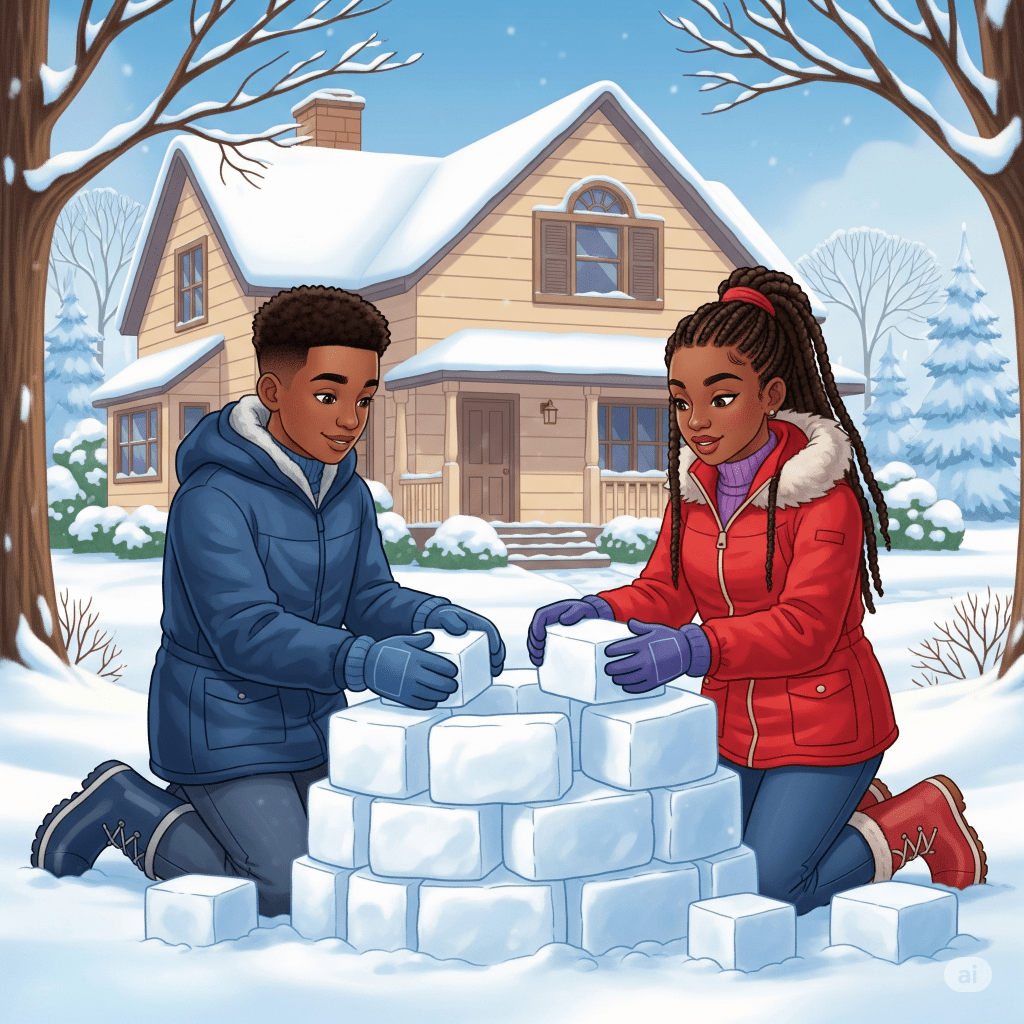
Over the next week, I started to settle in. Aunt Molly let me help with dinner. Uncle Dean showed me how to split kindling for the fire. I even started to get along with Katie—kind of. We worked on the snow fort every day, adding towers and digging out tunnels.
Then, one evening, Uncle Dean called me into his office.
“I want to talk to you about something,” he said. “Your mom told us about what happened back home. About the fights. The school stuff.”
My stomach dropped. “She did?”
He nodded. “But I don’t care about your past, Jay. What matters is what you choose to do now. Here.”
I didn’t know what to say. No one had ever said that to me before. They always talked about consequences. Uncle Dean talked about chances.
The next morning, Katie found me early, already at work on the snow fort.
“You’re early,” she said, surprised.
“Couldn’t sleep,” I said, brushing snow off my gloves.
We worked for a while in silence. Then she said, “You know, I didn’t want you to come here.”
I didn’t answer.
“I thought you’d ruin things. I thought Mom and Dad would like you more.”
“I didn’t want to come either,” I admitted.
She looked at me for a long moment. Then: “Well, we’re both stuck, so we might as well finish the fort.”
That afternoon, the sky darkened. Snow started falling again. Our fort looked like something from a fairytale—white walls, icicle-covered windows, and towers that leaned just slightly. It wasn’t perfect, but it was ours.
And for the first time in a long time, I didn’t feel like I was surviving—I felt like I was starting over.
“Second Chances” by Nina D. Smith. Published by Bright Bunny Books © 2025. Retelling of “Katie” from Footprints: A Story of the Snow by Annette Lyster, originally published in 1889.
“Second Chances” is intended for students in grades 6–8, offering a relatable exploration of family, change, and resilience through the eyes of a thirteen-year-old adjusting to a new life.
 Bright Bunny Books