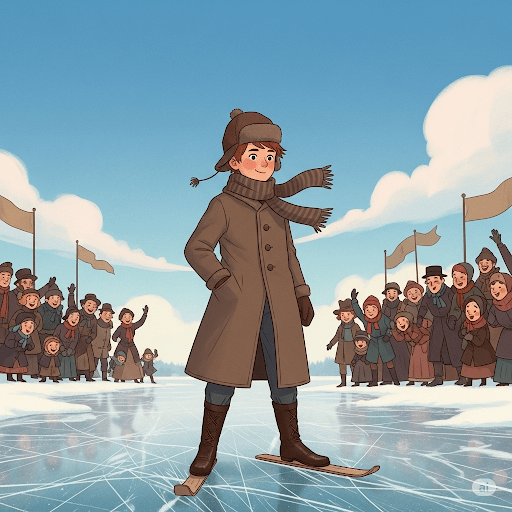
It was a freezing Saturday afternoon in February 1898, and most of Rudskill had gathered along the riverbank to watch the annual winter skating race. It was the biggest event of the season, especially for the boys of the local Zero Club—a group of teens who prided themselves on braving the coldest weather and training for outdoor challenges in the harshest winter conditions. Winning the race meant more than bragging rights; it meant earning a spot on the spring trip to the Adirondacks, sponsored by a few generous townsfolk.
Harry Webb had trained for weeks and was leading the pack. His skates cut sharp lines into the frozen river as the wind pushed against his cheeks. He was focused, determined—until a piercing scream shattered his concentration.
To his right, away from the race path, a patch of ice had given way. Someone was in the water.
Harry glanced over. His heart dropped. It was Minnie Woodruff—his best friend’s younger sister—struggling to hold on at the edge of the broken ice.
“Don’t let go, Minnie!” he shouted, veering away from the racecourse.
A few voices in the crowd gasped.
“Where’s he going?”
“Did he fall?”
But Harry wasn’t thinking about the medal or the trip. He was already running.
As he reached the edge of the cracked ice, Harry pulled two skate straps from his coat pocket—extras he carried in case his clamps failed. He buckled them together, wrapped one end around his hand, and crawled as close as he dared.
“Minnie!” he called. “Grab the strap!”
She was too cold to speak but managed to reach for the strap and hold on weakly.
Harry began to pull. But before he could make progress, the ice beneath him cracked with a terrible groan.
Crash!
He plunged headfirst into the freezing water.
The cold slammed into him like a wall. For a moment, he couldn’t move—but somehow, he held onto the strap. He surfaced and grabbed Minnie with his free arm.
“I’ve got you,” he said through chattering teeth.
“I’m so cold,” she whispered, barely able to hold on.
“Help!” Harry cried out with the last of his strength. “Help us!”
A few people had seen him leave the race and now ran toward the riverbank. One boy threw out a long scarf, which Harry tied around Minnie’s wrist. Soon, Boxy Woodruff—Minnie’s older brother—arrived with a wooden plank.
“Get back!” a man shouted. “The ice can’t hold us all!”
They pushed the board out across the ice. Harry grabbed it with one hand, pulling himself and Minnie up slowly. The ice groaned but held.
Boxy dropped to his knees and pulled his sister into his arms just as she began to faint.
The boys surrounded Harry. “You’re a hero!” one shouted.
Jack Bascoe, who had won the race, handed Harry his coat. “You deserve the medal more than I do,” he said.
Harry shook his head. “You finished. You earned it.”
“But you would’ve won.”
“I didn’t need to win today,” Harry said. “Not like that.”
Soon, a sleigh appeared, driven by old Mr. Grimes. “Get them in before they freeze!” he called.
Minnie and Harry were bundled up and rushed home. That night, Harry sat by the stove, tired but warm. Jack and Andy Bascoe stopped by.
“You really gave up your chance at the Adirondacks trip,” Jack said. “I wish there was a way to make it up to you.”
Harry smiled. “I’ll earn the money. One way or another.”
The next morning, Mr. Woodruff, just returned from New York, visited Harry’s home.
“You saved my daughter,” he said, gripping Harry’s hand. “That’s not something I can repay—but I’m going to try.”
Before leaving, he handed Harry an envelope. Inside was a note:
“Please accept this toward your Zero Club trip. With our deepest thanks.”
And folded behind it was a crisp twenty-dollar bill.
Harry looked at it for a long moment. His mother watched quietly. Finally, he said, “I guess I’m going to the Adirondacks after all.”
“Rescue on the Ice” by Bright Bunny Books © 2025. Retelling of “A Moment of Peril” from The Tour of the Zero Club by Captain Ralph Bonehill, originally published in 1902.
“Rescue on the Ice” is best suited for students in grades 7–10, offering age-appropriate language, mature themes of courage and sacrifice, and a historical setting that encourages reflection and discussion.
 Bright Bunny Books