By six o’clock, the café near Lincoln High had emptied out. The hum of the espresso machine had quieted, and the windows glowed gold against the deepening dusk. Nora Bennett sat at a corner table, legs tucked beneath her, turning a spoon slowly in her tea. Across from her, Marcus Lin stared into the last swirl of his hot chocolate, silent.
“I miss the version of you who argued about everything,” she said finally. “Even stupid stuff. Like whether vending machine cookies should count as lunch.”
Marcus smirked faintly but didn’t look up.
“You’ve been quiet for weeks. Not just tired—absent.”
“I’m here,” he said.
“No, you’re not,” she replied. “You’ve checked out. And I don’t think it’s just about football.”
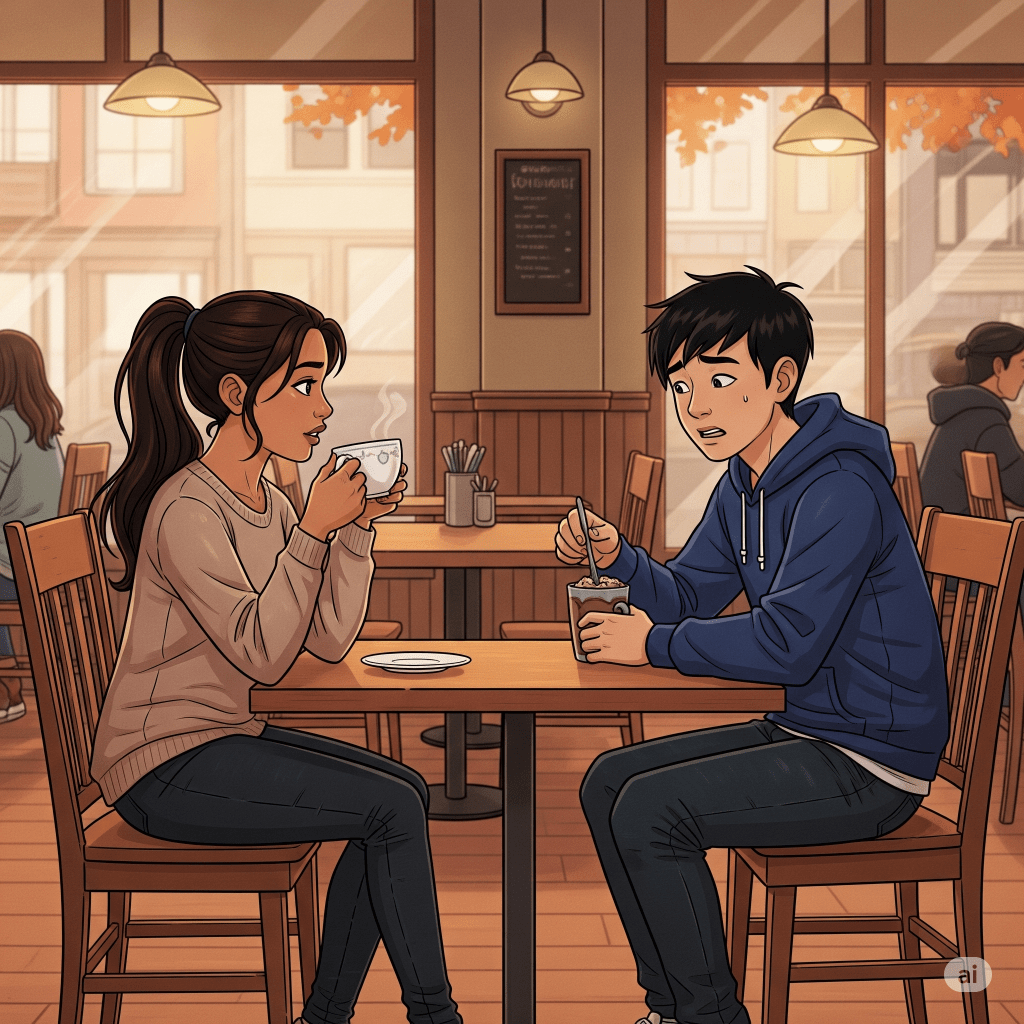
He shifted in his seat, jaw tight. “Coach benched me, Nora. Said I lost focus, wasn’t training hard enough. Maybe he’s right.”
“You believed him that fast?”
Marcus ran a hand through his hair. “I don’t know what I believe anymore. Football was the only thing I was ever really good at. It kept everything else in line. School, home. Me.”
Nora let that hang there a second. Then she leaned in.
“You know I quit piano sophomore year, right?”
“You used to play piano?” he asked, startled.
“Yeah. For ten years. I thought it defined me. Thought if I let it go, I’d disappear.”
“So what happened?”
“I found other sounds,” she said. “Other things I could care about without falling apart if they didn’t care back.”
Marcus looked at her. “That easy, huh?”
“No. It sucked. But I think the falling part’s where you find out who you are.”
He shook his head, not ready to agree but not disagreeing either. “I don’t know where to start.”
“You said once you pitched in middle school,” Nora said. “Said it used to clear your head.”
He raised an eyebrow. “That was a long time ago.”
“Doesn’t mean it can’t be part of you again. Even if it’s messy.”
Marcus blinked, like he hadn’t considered that option.
“Listen,” she continued. “I know you’re not trying to get back on the football team. But maybe it’s not about getting back to anything. Maybe it’s about trying forward instead of backward.”
He tapped his fingers against his empty cup. “You think if I throw a few baseballs, everything will fix itself?”
“No. But I think showing up for something—anything—starts to matter again after a while.”
He hesitated. “You’d really catch for me?”
“I’ve got decent hands,” she said. “Third base, remember? I can handle whatever disaster your aim throws at me.”
He laughed, really laughed this time, and the tension in his shoulders loosened just slightly.
They sat in the quiet for a moment longer. A delivery truck beeped outside. The barista wiped down the counter and dimmed the lights near the register.
Marcus stood. “Field behind the gym?”
“Tomorrow after school,” Nora confirmed. “And don’t flake.”
“I won’t,” he said. “I think I need this.”
She nodded. “We both do.”
As they stepped into the cold air, the night stretched wide and open around them—not a fix, but maybe a beginning.
“Out of Season” by Nina D. Smith, published by Bright Bunny Books © 2025. Retelling of Chapter III of Nid and Nod by Ralph Henry Barbour, originally published in 1923.
“Out of Season” is best suited for high school students in grades 9–12, offering relatable themes of identity, friendship, and resilience in a modern, emotionally resonant context.
 Bright Bunny Books