Peter slouched in front of his laptop, scrolling through lines of code. Ever since he was little, he’d been building and fixing programs—first for his dad, now for local businesses that needed simple websites. Everyone said he was talented. But lately, the same work felt repetitive, like solving the same puzzle again and again.
This morning was worse. He’d been up since four trying to debug a project that refused to run. The plan had been to finish early so he could attend a special workshop at the community center, where a well-known app developer was speaking. Peter wanted badly to go, but the bug had eaten his whole morning. Now he sat tapping his pencil against the keyboard, annoyed.
Andrew, his best friend, popped up on video chat. “Peter, come on! The workshop’s starting. This speaker’s supposed to be amazing—you don’t want to miss it.”
“I can’t,” Peter muttered. “I have to get this program fixed.”
“You always say that,” Andrew replied. “You said you wanted more than just fixing websites. Then show up.” He signed off before Peter could argue.
A few minutes later, Peter’s inbox pinged with a message from the workshop organizer: “Overflow crowd—speaker wants to livestream from different spaces. Can we use your setup?”
Peter hesitated, then replied: “Sure. I’ll set it up.”
Soon the speaker appeared on Peter’s screen. She wasn’t flashy, but she had the kind of calm focus Peter admired. “Thanks for helping me connect,” she said. “Looks like you’ve got code open. Want me to take a look while we’re setting up?”
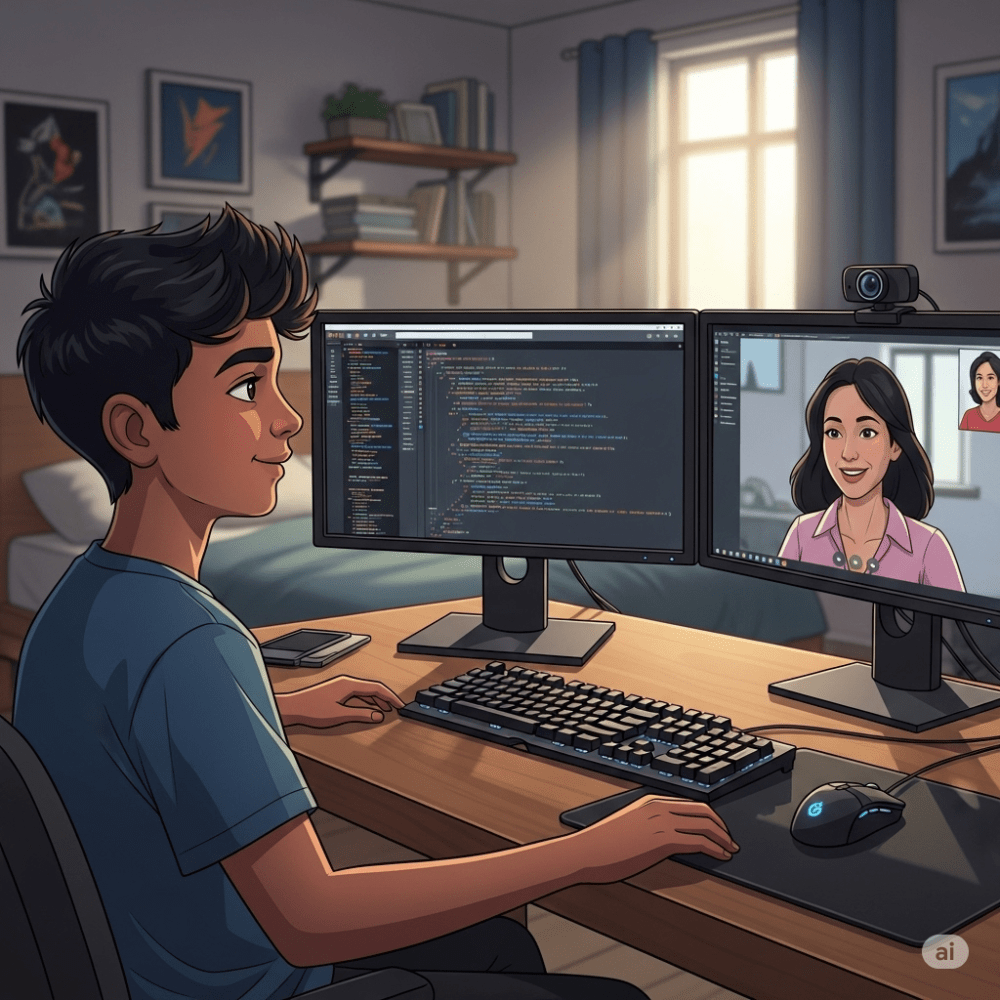
Peter froze. “It’s just… a dumb bug. I’ve been stuck all morning.”
“Show me,” she said.
Peter shared his screen. She leaned in, scanning the code. “Ah—see here? You’ve got a variable defined twice. That’s why it keeps looping. Delete one line and rerun.”
Peter tried it. The program clicked into place, smooth as ever. He blinked. “That’s it? I wasted five hours on that.”
“Not wasted,” she said, smiling. “You were close. Sometimes it just takes fresh eyes.” She paused. “But here’s the bigger question: are you only fixing code for other people, or are you building things you care about?”
Peter hesitated. He’d never thought about it that way. “Mostly fixing,” he admitted.
She nodded. “That’s fine for practice. But the fun comes when you chase your own ideas. Even small ones. That’s how I started—making an app that just helped my brother keep track of his chores. It was nothing fancy, but I loved it. That’s when I knew this was worth it.”
Peter felt something shift. He’d been waiting for proof that there was more than endless debugging. And here it was, not in some big speech, but in a line of code fixed in seconds and a reminder that he could build his own projects, not just patch someone else’s.
He grinned. “Okay. Then I guess I need to stop just cleaning up other people’s websites.”
“Exactly,” she said. “Start something that matters to you. Doesn’t have to be huge. Just make it yours.”
When the livestream wrapped up, Peter shut his laptop with a new kind of energy. For the first time in weeks, he knew exactly what he was going to do next—open a blank file and start something of his own.
“Lines of Change” by Nina D. Smith. Published by Bright Bunny Books © 2025. Retelling of “The Two Searchers” from Fireside Stories for Girls in Their Teens by Margaret W. Eggleston, originally published in 1921.
“Lines of Change” is well-suited for grades 5–8, since its relatable middle school setting, accessible language, and themes of frustration, perseverance, and discovering new possibilities mirror challenges and growth that students in this age group experience.
Here are three discussion questions you could use with this story:
- Peter feels stuck doing the same repetitive tasks. Have you ever had something you were good at start to feel boring? How did you handle it, and what did you learn from that experience?
- The speaker helps Peter solve a bug in minutes. Why do you think it’s often easier for someone else to see solutions we miss? How can collaboration or feedback improve your own work?
- The speaker encourages Peter to start building his own projects instead of only fixing others’. Why do you think pursuing your own ideas can feel more rewarding? What “project” might you want to start for yourself?
This content is provided under fair use for educational purposes only. Commercial use is strictly prohibited by the creator.
 Bright Bunny Books