Leah could spot problems faster than anyone. If the class got new pencils, she’d say the erasers were smudgy. If the playlist was updated, she’d say every song was overplayed. She wasn’t mean; she just had a habit of noticing what was wrong first.
“Can you try noticing what’s right, too?” her friend Jada asked one morning.
Leah shrugged. “I would, if there was anything.”
Their homeroom was planning a booth for the Spring Fest—a mini-carnival to raise money for field trips. Ms. Lopez, their teacher, held up a sketch. “Photo booth with props, simple snacks, and a ‘Guess the Jellybeans’ jar. Clean, easy, fun.”
Leah squinted. “Props wrinkle. Balloons pop. Jellybeans get sticky. And that corner of the gym is terrible lighting.”
Jada exhaled. “We haven’t even started.”
Ms. Lopez smiled, patient. “New rule: if you point out a problem, bring a fix with it. I call it ‘Find it, Fix it.’”
Leah folded her arms. “Fine. Use natural light near the side doors, not the corner. And put the props in clear bins so people can see them.”
“Great,” Ms. Lopez said, marking notes. “Keep going.”
All week, Leah kept finding flaws. Posters were crooked. Tape peeled. The jellybean jar looked cloudy. She grumbled each time, then felt Ms. Lopez’s eyes on her. “Fix it,” the teacher would remind.
So she straightened posters with a ruler, swapped tape for clips, and cleaned the jar with glass spray. It didn’t feel like winning, but it did feel…useful.
On Friday afternoon, the gym buzzed with booths. The air smelled like popcorn and cotton candy. Jada clipped the last prop tag and checked the cash box. “We’re set.”
Leah checked the outlet by the photo backdrop. “Bad news,” she said. “This plug is dead. The ring light won’t turn on.”
Jada’s shoulders tensed. “We need that light.”
She felt the usual words rise—This is why I said the corner was bad—then heard Ms. Lopez’s rule in her head. Find it. Fix it.
“I’ll move us,” Leah said. “See that spot near the side doors? Bright, no glare.”
Ms. Lopez nodded. “Go for it.”
They slid the backdrop six feet, shifted the table, and opened one door for more sun. People drifted over. The first group posed with fuzzy hats and cardboard sunglasses. Jada counted bills and smiled. “It works!”
Half an hour later, a small line formed—and the printer jammed. A blinking red light flashed ERROR.
Leah felt the old habit stir again. Cheap printer. We should have tested it twice. She caught herself. “Fix,” she whispered. She lifted the tray, freed the bent page, and tested another print. Still jammed.
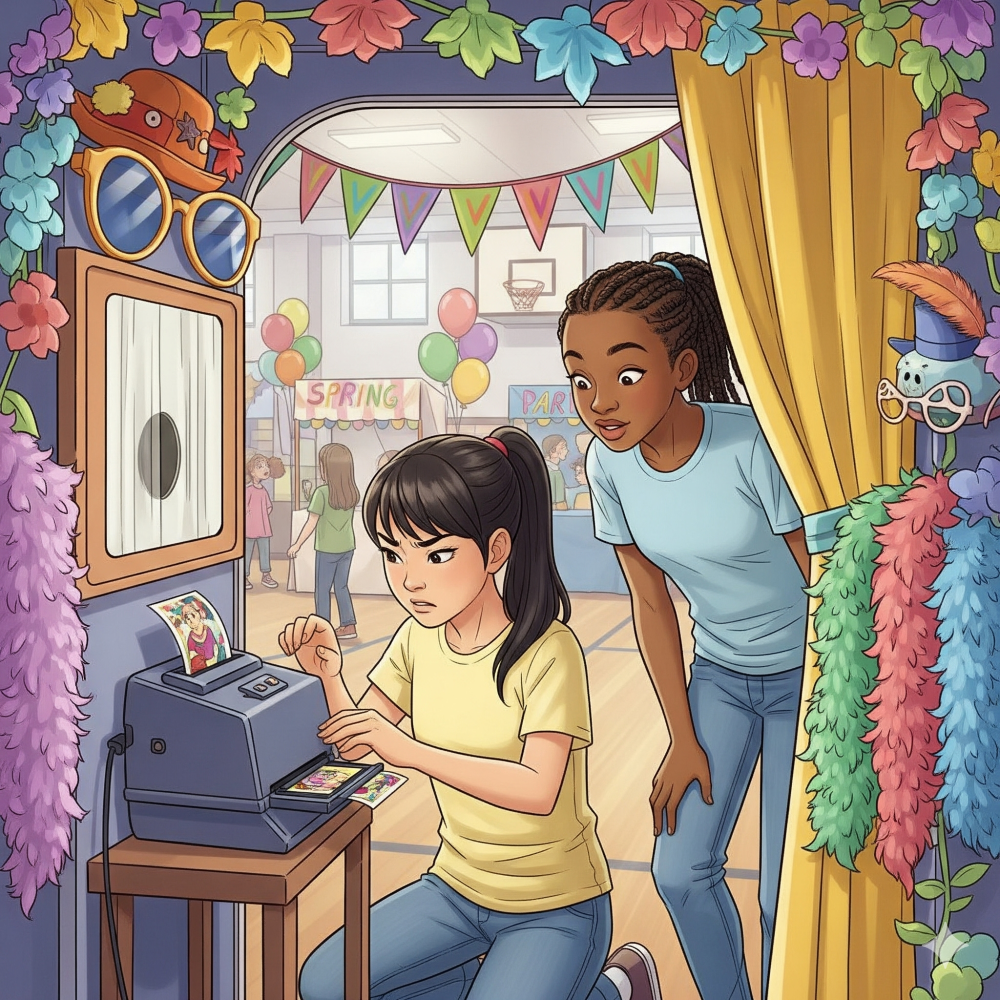
“Plan B?” Jada asked.
“Wi-fi share and email,” Leah said. “We’ll take the photo on my phone and share it right away. People can print at home.” She scribbled a quick sign: Instant Digital Photos—Scan Here and pulled up a QR code linked to a folder.
Ms. Lopez raised an eyebrow. “Fast thinking.”
“It’s not perfect,” Leah said, “but it’s something.”
It turned out students liked the digital plan even more. They took pictures, scanned the code, and squealed when the photos arrived on their phones. Someone asked for a boomerang video. Another wanted a gif. Jada leaned in. “We can make that work.”
Near the end of the night, a gust of air from the open door knocked over the prop bin. Feathers and mustaches tumbled across the floor. A week ago, Leah would’ve said, “Told you.” Tonight, she clapped twice. “Clean sweep!” She and Jada grabbed a broom and reset the bin with a roll of tape across the lid.
When the principal announced totals, their booth had raised the most money. Jada whooped. Ms. Lopez clapped once, then looked at Leah. “How did ‘Find it, Fix it’ feel?”
She thought about the dead plug, the jammed printer, the flying props. “Like carrying a toolbox instead of a megaphone,” she said. She smiled at her own metaphor. “I still noticed every problem. I just…did something.”
Jada bumped her shoulder. “Keep that setting on.”
On Monday, Ms. Lopez returned the poster sketches. “We’ll share tips with other classes for next year’s Fest. Who wants to present?”
Leah lifted her hand before the old habit could talk her out of it. “I’ll do it. First tip: choose your light. Second tip: test your tech. Third tip…” She glanced at Jada, who grinned. “…If you spot a problem, bring a fix with it.”
She still saw crooked lines and peeling tape everywhere. But now, when she saw them, her brain reached for the toolbox first. And that small switch made everything else feel brighter.
“Find It, Fix It” by Nina D. Smith. Published by Bright Bunny Books © 2025. Retelling of “The Growler” from The Parkhurst Boys and Other Stories of School Life by Talbot Baines Reed, originally published in 1914.
“Find It, Fix It” fits grades 6–8 because it highlights problem-solving, responsibility, and collaboration—skills middle schoolers are developing both in classrooms and in group activities with peers.
Discussion Questions
- What rule did Ms. Lopez create that helped Leah change her approach to problems?
- How did Leah’s actions at the Spring Fest show her growth?
- Why is it important to pair criticism with solutions in school or daily life?
This content is provided under fair use for educational purposes only. Commercial use is strictly prohibited by the creator.
 Bright Bunny Books