In 1850, gold fever was sweeping across America. Stories of fortunes hidden in California hills spread like wildfire. From cities and farms, people packed wagons, hoping to strike it rich.
Seventeen-year-old Felix Brighton wasn’t dreaming of gold. He just wanted to fix up the small hilltop cottage where he and his younger sister, Barbara, now lived while their parents worked long hours in town. The house was half-finished, the roof leaked, and the apple trees their father had planted were barely taller than saplings. Still, Felix liked the quiet. He played his violin each evening on the porch while Barbara drew pictures in the fading light.
One autumn afternoon, a traveler passed by the lane. His coat was patched, and his boots dusty. “Heard of the gold out West?” he asked, showing them a worn newspaper. “It’s real. They’re pulling it from rivers with their bare hands. You’ve never seen anything like it.”
Felix scanned the article. Gold in California. Men finding nuggets in streams. A fortune waiting in the hills.
That night, while Barbara slept, Felix sat outside, staring at the trees swaying in the wind. He thought of how slowly the house was coming together, how little money there was to fix anything.
“If I go,” he thought, “I could come back with enough to finish the cottage. Maybe even buy land. Something solid. Something better.”
The next morning, he told Barbara.
“You’re going to California?” she said, wide-eyed. “But what about the house?”
“I’ll be back in a few months,” he said. “And when I return, you’ll have real windows and a fireplace that doesn’t smoke.”
Barbara frowned. “I don’t want a better fireplace. I want you to stay.”
Felix hesitated—but the image of golden rivers and a real home was too strong. He left that afternoon with a wagon train heading west.
The trail was long and dusty. Days were hot; nights were cold. Felix worked odd jobs in small towns to earn food. When he wasn’t hauling supplies or cleaning stables, he played his violin at inns for a few coins. The sound reminded him of home.
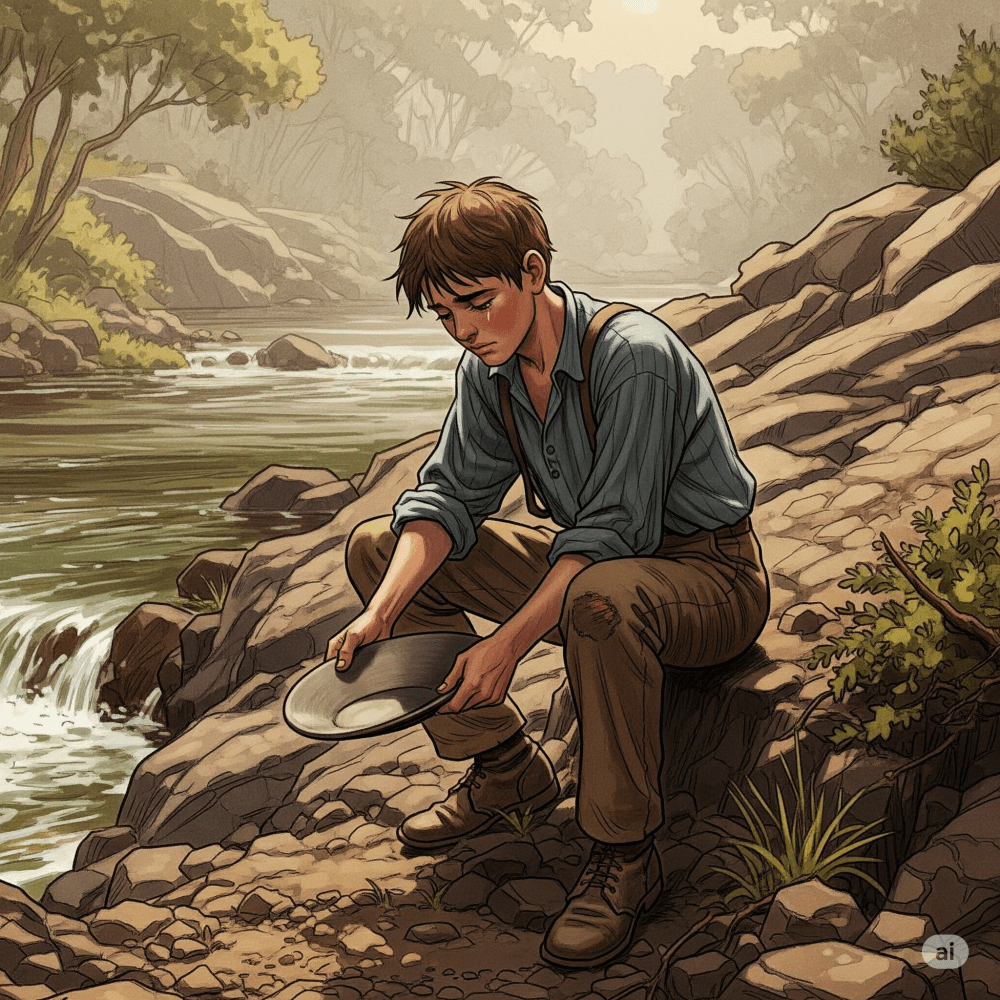
When he finally reached the hills near Bear Creek, he joined a group of miners. He panned for gold in icy water and dug into rocky slopes. His fingers were blistered, his boots worn through. He found a few flakes—but nothing like what the newspapers promised.
One night, an older miner invited him into a cabin during a rainstorm. They sat by a crackling fire, and the man leaned in.
“There’s a valley farther south,” he said. “Harder to reach, but richer than anything here. I’ve seen it. You and I—we could go.”
Felix stared into the flames. Gold had brought him far—but it hadn’t brought him closer to what he really wanted. He pictured Barbara sitting on the porch, sketching in her notebook. He missed her laugh, her questions, the way she tapped her pencil when she was thinking.
“I didn’t come out here to chase the next big thing,” Felix said quietly. “I came to build something. And I already have it.”
He left Bear Creek the next day.
Weeks later, just as the first blossoms returned to the apple trees, Felix climbed the hill to the little house. Barbara was in the garden, her hair tied back, a sketchbook in her hands. When she looked up, she dropped her pencil.
“You came back,” she said, running to him.
“I didn’t find much gold,” he admitted. “But I brought something better.”
That night, Felix unpacked his violin. He sat on the porch, playing softly while Barbara drew by lantern light. Outside, the trees rustled, and the wind carried music down Apple Tree Lane.
“Felix and the Gold Rush Dream” by Nina D. Smith. Published by Bright Bunny Books © 2025. Retelling of “The Fiddler of Apple Tree Lane” from The Windy Hill by Cornelia Meigs, originally published in 1922.
“Felix and the Gold Rush Dream is ideal for middle school readers in grades 6–8, offering a relatable mix of adventure, family loyalty, and personal growth set during the exciting era of the California Gold Rush.
 Bright Bunny Books