In the busy city of Meshed, there lived a kind man named Abdullah and his ten-year-old son, Ahmed. Life was not always easy for them—some days they had enough to eat, and other days they went to bed hungry. Still, they faced each day with hope. Whenever his father came home looking tired or worried, Ahmed would smile and say, “Don’t worry, Father. Tomorrow will be better.”
One hot afternoon, on his way to school, Ahmed stopped by a stream running through the center of town. People were busy everywhere—washing clothes, watering camels, and rinsing colorful cloth from the dye shops. Suddenly, a parade came down the street. There was music, bright flags, and the King himself riding a beautiful horse.
Behind the King was a small carriage, and out stepped a young princess. She spotted Ahmed in the crowd and smiled. “You have such a cheerful face,” she said. “Here, take this for good luck.” She handed him a small pouch filled with coins before the parade moved on. Ahmed couldn’t believe his luck!
But instead of keeping the coins for himself, Ahmed thought of his neighbors—people who needed food, water, or a bit of help to get by. With the money, he bought bread for families who had none, medicine for an old woman who was sick, and shoes for children who walked barefoot to school. His kindness made him well-loved in his town, and Abdullah felt proud to see his son thinking of others before himself.
When the money was gone, Abdullah and Ahmed decided to travel to the capital city to try their fortune. The journey was long and hot. They walked at night to avoid the heat and rested at roadside inns during the day. Sometimes kind travelers shared bread or dried fruit with them.
One evening, as they searched for a bridge across a wide river, a heavy rainstorm swept in. The wind howled, and the river rose so high they couldn’t cross. While they waited for the storm to pass, Ahmed heard a faint voice calling for help.
Following the sound, he found an old traveler sitting in the sand, shivering under a leopard-print shawl. “Could you get me some water?” the man asked. Ahmed filled his cup from the river and brought it back.
The man smiled weakly. “You’ve helped me when I needed it most,” he said. “Take this.” From around his neck, he lifted a small leather bag. Inside was a tiny cup made of clear crystal. “Each morning, place a drop of fresh water in this cup and look into it. You may see things that will help you or someone you care about.”
Ahmed thanked him and returned to his father. For several days, he tried the cup but saw nothing. Then, one morning, he peered inside and gasped. He saw the King’s palace and the princess looking very upset. It looked like something important had gone missing.
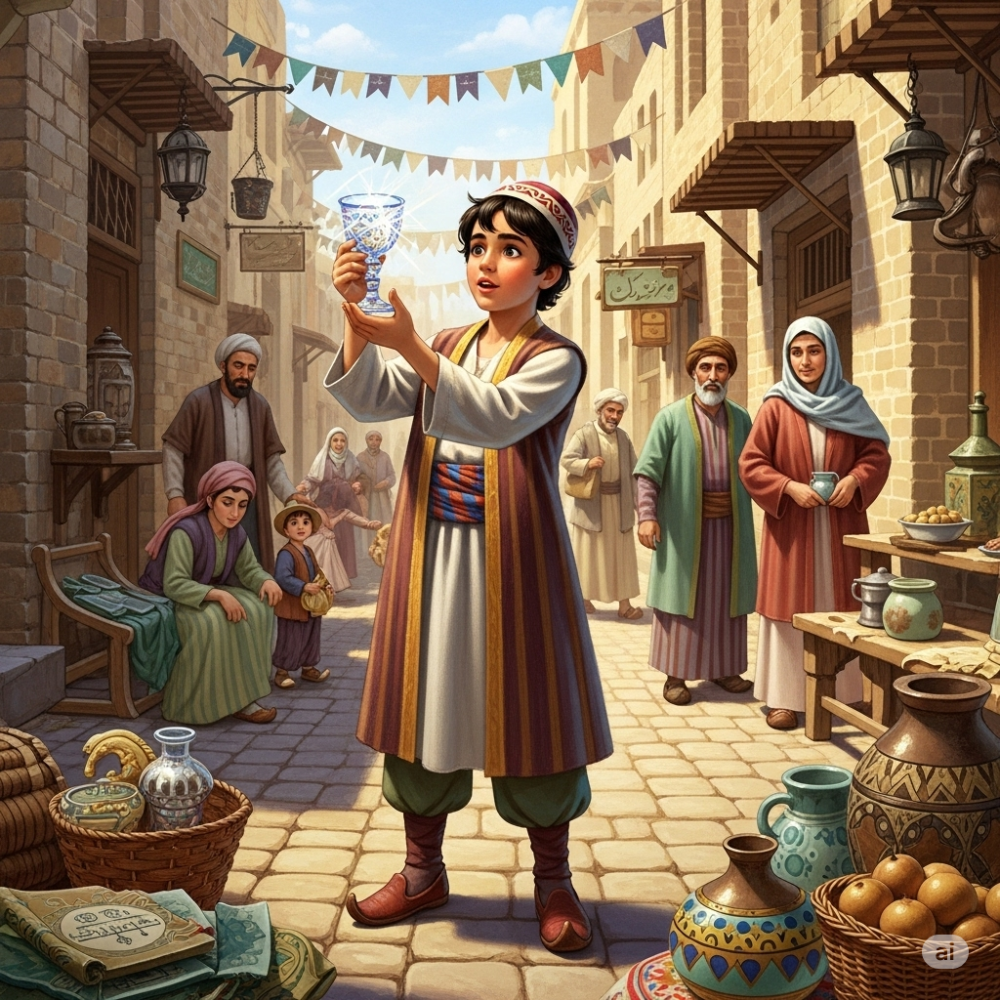
Ahmed rushed to the capital and asked to see the King. “I believe I can help,” he said, explaining what he had seen in the crystal. Guided by the vision, Ahmed and the palace staff searched the royal gardens—and there, under a flowering tree, was the princess’s lost necklace.
The King was amazed. “You’ve helped my daughter and my kingdom,” he said. “What reward would you like?”
Ahmed blushed. “I only wish for a good life for my father and me.”
The King smiled. “Then you shall have it.” He gave Abdullah a fine shop in the city and invited Ahmed to study at the royal library. From then on, Ahmed used the crystal cup only to help others, and he and his father lived happily, surrounded by friends, kindness, and opportunity.
And the little crystal cup? It stayed on Ahmed’s desk, always ready for the next adventure.
“Ahmed and the Crystal Cup” by Nina D. Smith, published by Bright Bunny Books © 2025. Retelling of “The Son of the Soap Seller” from Persian Fairy Tales by Hartwell James, originally published in 1906.
“Ahmed and the Crystal Cup” is ideal for grades 3–6, as its clear language, engaging plot, and themes of kindness, generosity, and problem-solving resonate with developing readers while encouraging positive values.
 Bright Bunny Books