Taylor
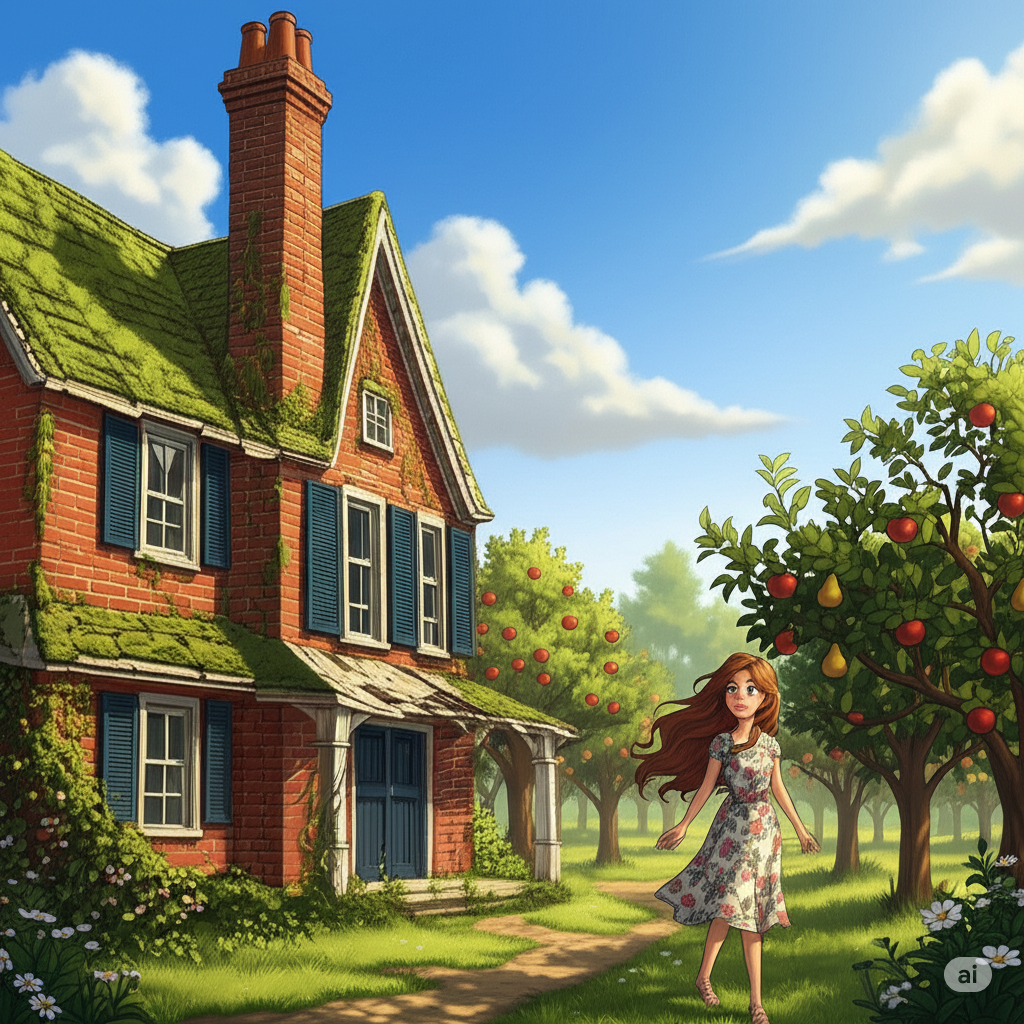
If you asked my parents why we moved from Chicago to rural Virginia, they’d say “a fresh start.” But it didn’t feel fresh. The house on Sycamore Lane was ancient, with red brick walls, mossy shutters, and a wide porch sagging under the weight of a hundred summers. I called it “The Old House,” like it was a character in a novel I hadn’t agreed to read.
My room had creaky floorboards, a fireplace with no fire, and a view of the overgrown backyard where an orchard used to be. Apple trees leaned in crooked rows, branches tangled with vines. “This place has history,” my mom had said.
Sure, and probably ghosts with gardening tools.
The locals called it Barrett House. Everyone seemed to know it. My science teacher said it had been built with bricks made from the red clay in the hills. Mr. John, our neighbor, said it once hosted fox hunts and Southern breakfasts with “real Brunswick stew” and “butter you could spread with a whisper.”
I didn’t care. I missed the sound of traffic outside my window, my friends, the city skyline.
But the house? The house seemed to care. When I sat on the porch alone, it felt like it was watching. Not in a creepy way. More like it was waiting for me to understand something.
Mr. John
When the O’Connor family bought the old Barrett place, half the town held its breath. Not because they were from the North—well, maybe a little—but because the house had been empty too long, and no one wanted to see it fall into ruin.
That house has stood on the hill since my great-grandfather’s day. Made from the land itself—red clay bricks, wooden shutters painted deep green. When I was a boy, my grandmother would say, “That house remembers, even if people don’t.”
And I believe it.
It saw young men leave for the Civil War and never come home. It fed generations from the orchard and smokehouse. And when progress came—telephone wires, gas lines, even those roaring cars—it never complained. It just stood tall, like it always had, proud and quiet.
Now Taylor, the teen girl from Chicago, sits on the steps most evenings. Headphones in. Hoodie up. She looks like she’s waiting for a ride that’s not coming.
I wave, sometimes offer extra tomatoes from the garden, but she doesn’t say much. Still, I think the house is getting through to her. Some places don’t use words to speak.
Taylor
It happened one night after a storm. The power had flickered all day, and the wind had knocked a shutter loose. I couldn’t sleep, so I went downstairs and sat on the porch.
The rain had stopped, but the sky was still low and dark. I looked out toward the orchard, where the trees leaned like they were whispering to each other. Then something caught my eye.
One of the shutters—on the second floor—moved. Just a creak and a swing, slow and steady, like a blink.
I knew it was probably nothing. A gust, maybe. But somehow, it felt like the house was saying, “You’re not alone.”
That week, I started exploring. I helped Mom dust off old photo albums left behind in the attic. I found a letter dated 1919, folded inside a drawer. It talked about planting daffodils by the porch. The next day, I noticed the daffodils still bloomed every spring. I texted a photo to my best friend back in Chicago. She said, “That’s kinda beautiful, actually.”
And maybe it was.
Mr. John
I saw Taylor with a rake the other day, clearing a path through the orchard. Her parents told me she’s taking photos for her art class. I nodded, but I knew it was more than that.
The Barrett house isn’t just walls and mortar—it’s a memory keeper. And Taylor? She’s starting to listen.
We talked a bit yesterday. She asked about fox hunts and old stew recipes. I told her stories—about silver trays, mint juleps, and the smell of hickory wood from the kitchen. She didn’t laugh. She asked questions.
Most kids don’t ask.
Taylor
The house isn’t scary anymore. It’s old, sure. But it’s patient.
When I play music in my room, the sound carries in strange ways, like it echoes through time. I swear I heard something tapping along with the beat once. Not creepy—like applause.
Sometimes I write at the window where the sun hits the bricks just right. I think about all the people who sat in this room before me. Kids who grew up here, who left and came back. People who laughed, cried, maybe even hated this place once like I did.
But they stayed.
And now, maybe I’m starting to understand why.
Mr. John
They say old houses fall apart when no one cares anymore. But this one—she’s strong. Because someone sees her.
And in return, she gives them roots.
“A New Day on Sycamore Lane” by Bright Bunny Books © 2025. Retelling of “The Old House” from The Old House and Other Stories by Blanche Sellers Ortmann, originally published in 1910.
“A New Day on Sycamore Lane” is best suited for middle school students in grades 6–8, as it explores themes of belonging, change, and connection through reflective narration and layered perspectives.
 Bright Bunny Books